How much does it cost to build a website in India?
If you’ve asked a few developers or agencies, you’ve probably seen very different quotes. One offers a website for ₹15,000, another asks for ₹75,000 or more for what looks like the same project.
The reason is that “a website” can mean a simple landing page, a professional business site, an online store or a custom web application with user accounts, dashboards and payments. Each needs a different amount of design, development, testing and upkeep.
Quick answer: how much does a website cost in India?
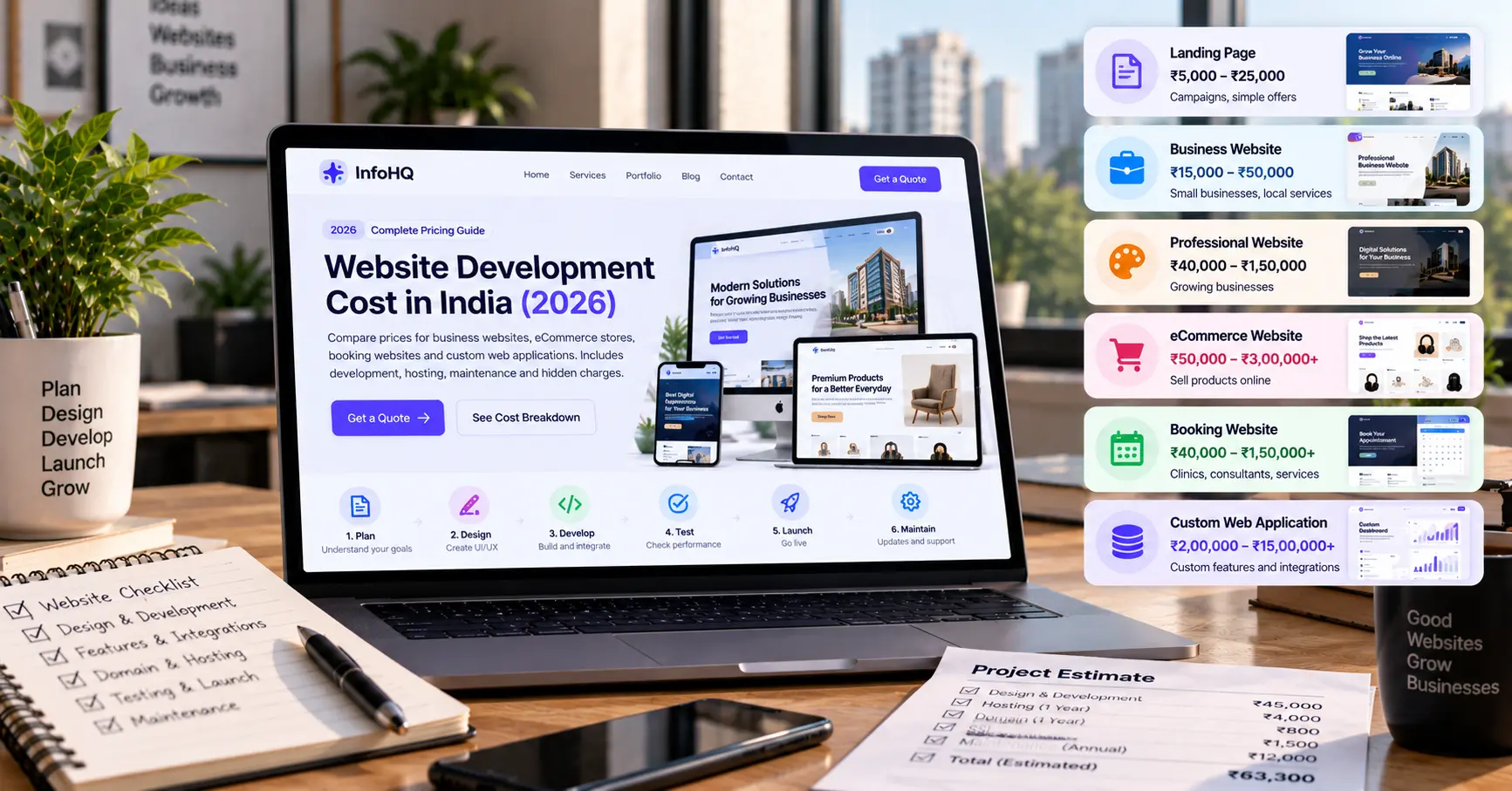
For 2026, a basic business website in India may cost around ₹15,000 to ₹50,000, a more customised professional website around ₹40,000 to ₹1,50,000, an eCommerce store around ₹50,000 to ₹3,00,000 or more, and a complex custom web application several lakhs or more.
These are indicative budgeting ranges, not fixed market rates, and not a quote for your project. They come from publicly available Indian website pricing guides and aren’t InfoHQ’s price list. Actual prices depend on scope, provider, technology and features. You’ll find our own starting prices on the pricing page.
| Website type | Indicative cost | Suitable for |
|---|---|---|
| Landing page | ₹5,000–₹25,000 | Campaigns, personal brands, simple offers |
| Basic business website | ₹15,000–₹50,000 | Small businesses, local service providers |
| Professional custom website | ₹40,000–₹1,50,000 | Growing service companies |
| Corporate website | ₹1,00,000–₹3,00,000+ | Established or B2B companies |
| eCommerce website | ₹50,000–₹3,00,000+ | Businesses selling products online |
| Booking or appointment website | ₹40,000–₹1,50,000+ | Clinics, consultants, service providers |
| Custom web application or SaaS | ₹2,00,000–₹15,00,000+ | Startups and software products |
| Complex enterprise platform | ₹10,00,000+ | Large organisations |
Some template-based projects cost less, and complex applications can go well beyond these ranges. Hosting, domain renewals, paid tools, third-party services, taxes and maintenance may be extra.
Website development cost by type
Landing page: ₹5,000–₹25,000
A single page designed to get one action, such as an enquiry, a booking or a purchase. It usually has a headline, benefits, an enquiry form or WhatsApp button, a responsive layout and basic SEO setup. The price rises with custom animation, several landing pages, copywriting or CRM integration.
Best for: new businesses testing an offer, ad campaigns and consultants.
Basic business website: ₹15,000–₹50,000
Typically five to eight pages: Home, About, Services, Portfolio, Blog and Contact, with a contact form, WhatsApp link and a responsive layout. At this level, check whether the quote includes original design or only a customised template, and whether you can edit text and images yourself after launch.
Best for: local businesses, consultants and early-stage companies.
Professional website: ₹40,000–₹1,50,000
More attention goes to branding, user experience, content structure and conversion. Expect customised design, multiple service pages, a blog or CMS, lead capture with CRM integration, analytics, technical SEO foundations and performance work.
Best for: growing service companies, software businesses and brands that depend on their website for leads.
Corporate website: ₹1,00,000–₹3,00,000+
Corporate sites need more content, several service lines, advanced navigation and sometimes multilingual pages or links to internal systems. A corporate site doesn’t automatically need a huge budget. The main drivers are the number of unique page layouts, content complexity, integrations and the quality of work required.
Best for: established companies and B2B organisations.
eCommerce website: ₹50,000–₹3,00,000+
Product pages, cart and checkout, payment gateway, order and inventory management, shipping rules, customer accounts and discount codes. Cost depends on the number of products and variations, integrations and whether you use a hosted platform or custom development. Payment gateway charges, platform subscriptions, paid extensions, shipping services and product photography are usually separate.
Best for: retailers, direct-to-consumer brands and manufacturers.
Booking or appointment website: ₹40,000–₹1,50,000+
Service listings, availability, booking forms, notifications and sometimes payments and customer accounts. A simple appointment form is far less work than a real-time system that syncs several calendars, manages staff schedules and takes payments.
Best for: consultants, clinics, trainers and salons.
Custom web application or SaaS: ₹2,00,000–₹15,00,000+
This goes beyond a marketing site. Users may log in, manage data, use dashboards or subscribe to a service. Think customer portals, CRMs, internal tools and software products. It needs frontend, backend APIs, a database, authentication, permissions, testing and deployment, and it can cost well over ₹15 lakh when it involves heavy integrations, sensitive data or large user numbers.
Best for: startups building software and businesses whose needs a standard website platform can’t meet.
What affects the cost?
Two websites with the same number of pages can cost very different amounts. The main reasons:
- Design complexity: a template-based site needs less design work than a fully custom one with unique layouts and interactions.
- Number of unique layouts: ten pages on one reusable layout can cost less than five pages that each need their own design.
- Features: a contact form is simple. Logins, dashboards, payments, booking and complex workflows add development and testing.
- Content: copywriting, product descriptions and photography may need budget. If you supply organised content, you can reduce the time your developer needs.
- Technology: WordPress, Shopify, hosted builders and custom frameworks such as React or Next.js each have different costs and trade-offs. The right choice depends on functionality, editing, integrations and long-term upkeep, not on what’s popular.
- SEO scope: basic technical SEO is different from a full SEO engagement. More on this below.
- Integrations: CRM, payments, inventory, calendar, email marketing or automation tools. Some come as ready-made plugins, others need custom API work.
- Testing, security and maintenance: device testing, bug fixes, backups and monitoring should be planned from the start.
Freelancer, agency, in-house or website builder?
| Option | Advantages | Things to consider |
|---|---|---|
| Freelancer | Direct communication, often a lower upfront cost | Availability, specialist coverage and continuity vary |
| Agency | Several skills and a structured process | Project management overhead can raise the price |
| In-house developer | Direct control and ongoing access | Salary, hiring and tools are continuing costs |
| Website builder | Quick setup, little technical effort | Limits on customisation and integrations, plus subscriptions |
There’s no universally best option. A capable freelancer or a website builder may be enough for a small brochure site. A custom application with several integrations usually benefits from a team that covers design, development, testing and deployment.
A builder can look cheaper at first, but remember the subscription fees, premium features, transaction charges and the cost of moving later if your needs change. The lowest upfront cost isn’t always the lowest total cost over a few years. When you compare providers, compare what they’ll deliver and who is responsible for what, not just the final price.
Hidden costs and maintenance
The development quote is only one part of the total.
| Expense | What to check |
|---|---|
| Domain name | Registration, renewal and who owns it |
| Hosting or platform subscription | Capacity, bandwidth and renewal rates |
| SSL, security and backups | What’s included and what costs extra |
| Premium plugins or themes | Annual licences and renewals |
| Email services | Mailboxes, transactional email and sending limits |
| Content creation | Copywriting, photography and translation |
| Third-party integrations | API usage, subscriptions and setup |
| Taxes | GST and other applicable taxes |
Domain registration may cost hundreds to a few thousand rupees a year. Hosting can range from cheap shared plans to much more expensive managed or cloud infrastructure. Prices vary by provider, plan, traffic and renewal terms.
Maintenance covers the work that keeps a site secure and working: software updates, backups, bug fixes, security monitoring, performance checks, form and integration testing and small content changes. A simple informational site may need only occasional support. An eCommerce store or custom application may need regular monitoring and a monthly support agreement. Ask whether support includes a set number of hours, response times, emergency fixes and backups, because these are different services.
Before you sign, ask for a written breakdown of one-time charges, recurring charges, exclusions and renewal costs.
Does the cost include SEO?
Not necessarily. Some proposals include basic SEO foundations, while others quote SEO separately. “SEO-friendly website” can mean different things, so ask for a clear list of what’s included.
Basic technical SEO usually covers editable page titles and meta descriptions, descriptive URLs, mobile-friendly layouts, crawlable navigation, an XML sitemap, canonical tags, indexability checks, basic image and performance work and relevant structured data.
Ongoing SEO is a separate effort: keyword research, content planning and publishing, improving existing pages, local SEO, technical audits, backlinks and Search Console monitoring.
A technically sound site is a foundation, not a guarantee of rankings. Results depend on competition, content quality, site authority and how well the site serves its visitors. Google’s SEO Starter Guide and its guidance on helpful content are good places to start.
How to get an accurate quote
- Define the goal. Leads, product sales, a portfolio, publishing content or a software service.
- List the pages. Home, services, about, contact and any special pages.
- List the features. Forms, blog, customer login, payments, booking, CRM integration or automation.
- Decide who supplies content. Text, branding, product information and images.
- Share a realistic budget and launch date, so providers can propose something achievable.
- Compare proposals line by line. Design, development, testing, SEO setup, hosting, training, revisions, maintenance and support.
- Confirm ownership. Who owns the domain, code, design files, content and paid accounts, and how access is handed over if you change providers.
Questions to ask a development partner
Price matters, but it shouldn’t be the only factor. Before you choose, ask:
- Have you built similar projects, and can I see live examples or case studies?
- What exactly is included in the proposal?
- Will the site work well on mobile?
- Can I edit content without asking you every time?
- What SEO and performance checks are included?
- Who owns the domain, code, design and accounts?
- What support is there after launch, and how are extra requests charged?
- What happens if the project is delayed or the requirements change?
A reliable provider explains trade-offs, documents the scope and helps you pick a suitable solution instead of pushing the most expensive one.
Frequently Asked Questions
What is the average website development cost in India in 2026? A basic business website may cost around ₹15,000–₹50,000, and a more customised professional website ₹40,000–₹1,50,000. eCommerce sites and custom applications can cost much more depending on their functionality. These are indicative ranges, not fixed prices.
How much does a 5-page website cost in India? A simple five-page website may fall around ₹15,000–₹50,000, depending on the design, platform, content, forms and integrations. A custom-designed site with advanced features may cost more.
Can I build a website for ₹10,000 in India? It may be possible for a simple landing page or a template-based site, depending on the provider and scope. Custom design, original content, advanced integrations and ongoing support may not be included at that budget.
How much does an eCommerce website cost in India? Around ₹50,000–₹3,00,000 or more. The final price depends on the platform, product catalogue, payment and shipping integrations, checkout requirements and design complexity. Platform subscriptions and transaction fees may be extra.
Are hosting and the domain included in the development cost? Sometimes. Some providers include hosting or a domain for an initial period, while others charge separately. Confirm the renewal price, backup policy and who controls the accounts. Ideally your business keeps direct access to its own domain.
How much does website maintenance cost in India? It depends on the site’s complexity and the support you need. A small informational site may need limited periodic maintenance, while an eCommerce store or custom application may need ongoing monthly support. Ask for a clear list of covered tasks and exclusions.
Does an expensive website rank higher on Google? No. Price alone doesn’t decide rankings. Technical quality, useful content, relevance, competition and reputation all matter. A well-built, affordable website can perform well if it meets users’ needs and follows sound SEO practice.
How long does it take to build a website? A simple landing page may take several days to a few weeks. A professional business website often takes a few weeks, while an eCommerce project or custom application can take several weeks or months. Content readiness, feedback, integrations and changing requirements all affect the timeline.
Where to start
Website development cost in India depends on what you’re building, how it needs to work and what support you expect after launch. A simple business site may be enough to establish your presence. A customised site makes more sense when you need stronger branding, lead generation and integrations. If you’re building a software product, budget for development, testing, security and ongoing support as well.
The best way to control the budget is to define the scope clearly, compare itemised proposals and put your money into the features that serve your business goals.
If you want to talk it through, see our web development services, mobile app development or business automation pages, or contact us with your requirements. If you’re also thinking about adding AI to your site, read AI agents vs AI chatbots.