How much does it cost to develop a mobile app in India?
It depends on what you want the app to do. A basic app with a few screens and simple features needs far less effort than an eCommerce app, a delivery platform or a SaaS product with user accounts, payments, real-time updates and an admin dashboard.
You may also get very different quotes for app ideas that look alike, because an estimate depends on more than the number of screens. Design, backend systems, integrations, security, testing and long-term maintenance all affect the total.
Quick answer: what does an app cost in India?
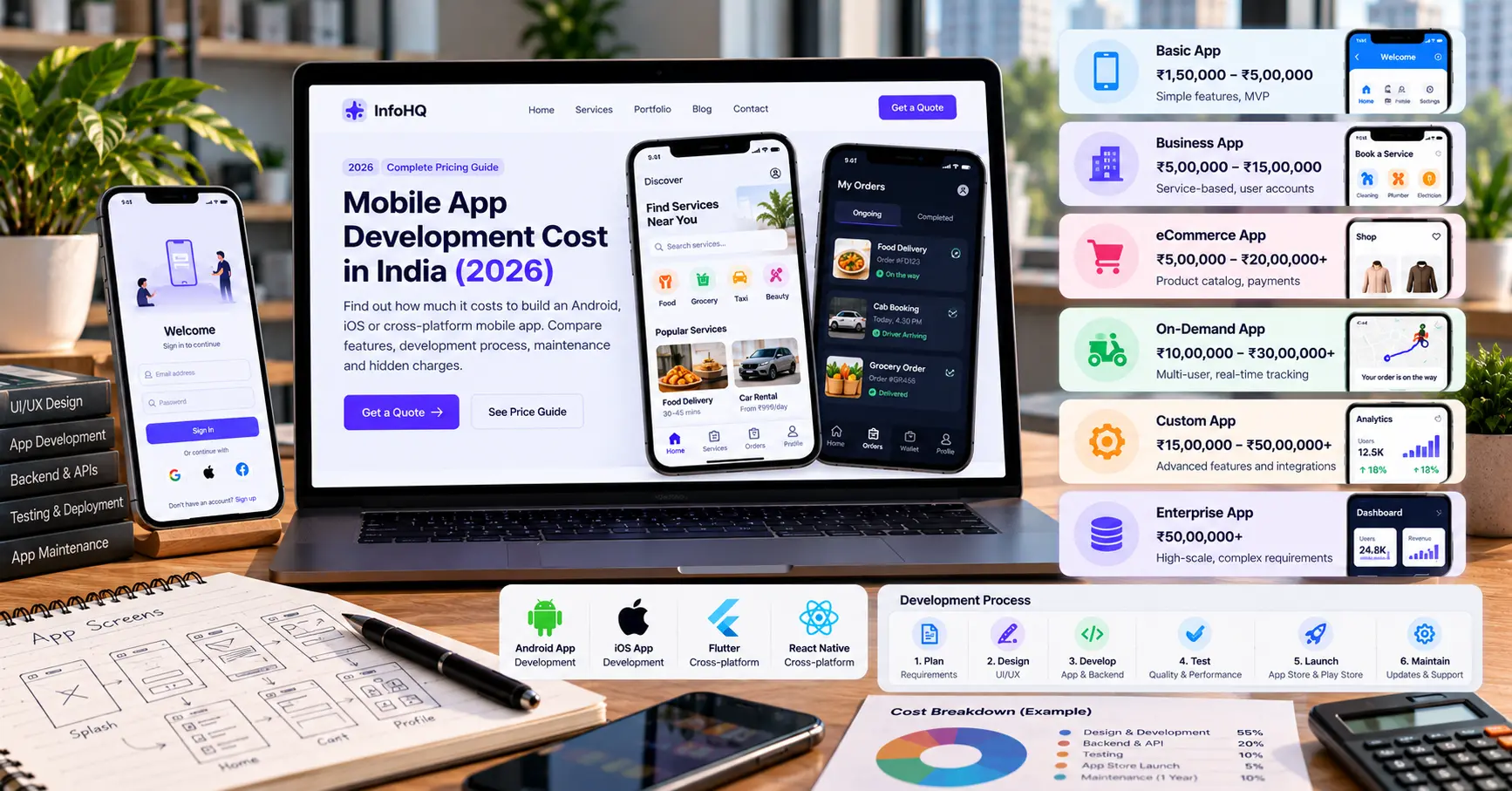
As a broad budgeting guide, a simple mobile app may cost around ₹1,50,000 to ₹5,00,000, a moderately complex app around ₹5,00,000 to ₹15,00,000, and a complex app ₹15,00,000 to ₹50,00,000 or more.
These are indicative planning ranges, not fixed industry rates and not a quote for your project. They aren’t InfoHQ’s price list either, which you’ll find on our pricing page. A very simple prototype can cost less, while a large or regulated platform can cost much more.
| App type | Indicative cost | Typical scope |
|---|---|---|
| Basic app or simple MVP | ₹1,50,000–₹5,00,000 | Few features, simple workflows |
| Moderately complex business app | ₹5,00,000–₹15,00,000 | User accounts, APIs, backend features, integrations |
| eCommerce or booking app | ₹5,00,000–₹20,00,000+ | Catalogues, payments, order or booking management |
| Delivery or marketplace app | ₹10,00,000–₹30,00,000+ | Several user roles, dashboards, real-time features |
| Complex custom application | ₹15,00,000–₹50,00,000+ | Advanced workflows, integrations, large backend |
| Enterprise or high-scale platform | ₹50,00,000+ | Heavy security, integrations and infrastructure |
Actual quotes depend on the feature list, design, platform coverage, integrations, backend, team, testing and support.
Cost by app type
Basic app or MVP: ₹1,50,000–₹5,00,000
A limited set of clearly defined features: a few screens, simple navigation, mostly static or simple dynamic content, an enquiry form and maybe a simple API. Cost goes up with logins, offline use, notifications, complex data sync or a custom backend.
Best for: early-stage businesses testing an idea, simple internal tools and limited-scope MVPs.
Business or service app: ₹5,00,000–₹15,00,000
More screens, connected data and interaction between users and the company: registration and login, profiles, database and API integration, push notifications, appointment or enquiry management, basic dashboards and admin controls. The estimate depends heavily on whether you already have a backend or need one built.
Best for: service providers, customer portals and small businesses offering services through an app.
eCommerce or booking app: ₹5,00,000–₹20,00,000+
Product or service listings, search and filters, cart or booking flow, payments, order or reservation history, notifications, customer accounts and admin tools. A single-vendor store is simpler than a multi-vendor marketplace with seller onboarding, commissions, disputes and separate dashboards.
Best for: retailers, service providers and companies selling directly to customers.
Delivery or on-demand app: ₹10,00,000–₹30,00,000+
These usually have several experiences: customers, delivery partners or service providers, and administrators. Expect real-time order status, maps and location, dispatch logic, payments and operational dashboards. Location tracking, background activity, reliability needs and third-party map services add both development and running costs.
Best for: delivery businesses, local service marketplaces and companies coordinating real-time operations.
Complex custom app: ₹15,00,000–₹50,00,000+
A mobile app combined with a substantial backend: SaaS products, fintech, healthcare platforms, large membership systems and enterprise workforce tools. These need stronger security, audit logging, advanced architecture, more testing and careful deployment, and regulated or enterprise apps can cost considerably more.
Best for: businesses with established requirements where the app supports important operations or revenue.
Android, iOS or cross-platform?
Your platform strategy changes how much work you’ll need to build and maintain.
| Approach | How it works | Budget notes |
|---|---|---|
| Android native | Built for Android only | Separate build and testing for Android |
| iOS native | Built for Apple platforms only | Separate build and testing for iOS |
| Two native apps | Two platform-specific builds | More development and maintenance effort |
| Cross-platform | One shared codebase | Reduces duplicated work, but some features still need platform-specific work |
| Progressive Web App (PWA) | Web app with app-like features | May suit apps with few native device features |
Android may be a sensible starting point if most of your users are on Android. iOS may suit you if your customers use Apple devices or you depend on specific iOS features, and release preparation should allow for Apple’s platform requirements.
Frameworks such as Flutter and React Native let teams share much of the code between Android and iOS. But cross-platform doesn’t automatically cost half as much as two native apps, because complex integrations, device features and testing can still need extra work. For some startups, launching an MVP on one platform, or going cross-platform, is a practical way to test demand before expanding.
What affects the cost?
- Number of features. Each feature adds design, build, testing and maintenance. A clear, prioritised list is one of the best ways to keep within budget.
- UI and UX design. Custom designs, animations, complex navigation and accessibility needs add effort.
- Backend and database. An app that shows static information is very different from one that syncs data across users, processes transactions and manages permissions.
- Third-party integrations. Payments, maps, messaging, analytics, CRM and other APIs take setup and may have recurring charges.
- Admin dashboard. Many apps need a web panel to manage users, content, orders or reports. If it isn’t in the first scope, it needs its own budget.
- Security and privacy. Authentication, access control, encryption and audit logs need planning and testing, and sensitive or regulated data may need extra review.
- Testing. Devices, OS versions, network conditions and unusual user behaviour all take time. A reliable estimate includes testing and bug fixing.
- Maintenance. OS updates, dependency changes, API updates and new features keep costing money after launch.
What about an app like Uber, Zomato or Amazon?
Well-known apps are a common reference, but copying their screens isn’t the same as building a comparable product. A basic delivery MVP is very different from a mature platform with real-time dispatch, logistics, payments, recommendations, fraud controls and large-scale infrastructure.
Instead of asking what an app like a famous brand costs, list the features you need. For a delivery platform, for example, separate the customer app, the delivery partner app, the admin dashboard, backend APIs and database, location services, payment and notification integrations and reporting. Estimate each part on its own. That makes it easier to find a realistic MVP budget and decide what can wait.
Hidden costs
The development quote may not cover everything needed to run the app.
| Expense | What to budget for |
|---|---|
| Backend hosting | Servers, database, storage and traffic |
| Third-party APIs | Maps, messaging, AI, analytics and other usage-based services |
| Payment processing | Gateway fees and settlement terms |
| App store accounts | Current account requirements and fees |
| Security and monitoring | Testing, crash reports, analytics and logging |
| Content and media | Images, video, copywriting and localisation |
| Customer support | Tools and people to handle user issues |
| Marketing | User acquisition and launch campaigns |
A location-based app may have recurring map charges, and an AI-enabled app may have model usage costs. These depend on actual usage and provider pricing. For current store account requirements and fees, check the Android Developers and Apple Developer documentation.
Ask for a breakdown of one-time development charges, recurring service charges, third-party subscriptions and optional future features.
How much does app maintenance cost?
Maintenance is the ongoing work that keeps the app running as users, operating systems and connected services change: bug fixes, OS compatibility updates, dependency and SDK updates, backend monitoring, security improvements, crash analysis, performance work and small changes.
A simple app with few integrations may need relatively little support. An app used for transactions, deliveries or critical workflows needs more monitoring. Rather than assuming a standard percentage, ask for a plan that spells out covered hours, response times, monitoring, infrastructure, bug fixes and what counts as new feature work.
How to reduce costs without cutting quality
- Start with an MVP. Build the smallest set of features that tests whether your product solves a real problem, before you build everything.
- Prioritise features. Sort them into must-have for the first release, should-have to follow and future ideas to revisit after you’ve validated the product.
- Reuse existing services. Authentication providers, payment gateways and analytics tools can save building from scratch. Check their long-term cost and limits first.
- Choose the right platform strategy. A cross-platform build or a single-platform launch may reduce duplicated effort.
- Prepare early. Clear user flows, content, branding and acceptance criteria reduce avoidable revisions.
- Plan for maintenance from day one. Clean architecture, testing, documentation and reliable deployment reduce support problems later.
The goal isn’t the cheapest developer. It’s the smallest reliable solution that meets your real requirements.
How to get an accurate quote
Prepare a short brief before you approach a development company:
- The problem. Who the users are, what they need and what the app solves.
- User roles. Customers, employees, administrators, delivery partners, vendors.
- Essential features. What the first release needs, separated from future ideas.
- Platforms. Android, iOS, both or a web alternative, and whether you need native device features.
- Backend. Whether you already have APIs, databases and admin tools or need them built.
- Integrations. Payments, maps, messaging, CRM, analytics.
- Deliverables. Scope, timeline, milestones, testing plan, source-code ownership, deployment duties and maintenance terms.
Then compare itemised proposals against the same requirements. A lower quote may leave out the backend, testing, deployment or post-launch support.
Questions to ask a development company
- Have you built apps with similar functionality, and can I see live apps or case studies?
- What does the quote include, and will you build the backend and admin dashboard?
- Which testing activities are included?
- Who owns the source code and assets?
- Will the app be published under my business’s own developer accounts?
- How are changes outside the agreed scope charged?
- What support is available after launch?
- How will progress, risks and delays be communicated?
Choose a provider that explains the technical trade-offs, documents the scope and helps you prioritise the right features. If you’re also planning a website, our guide to website development cost in India covers that side.
Frequently Asked Questions
What is the average mobile app development cost in India in 2026? A simple app may cost around ₹1,50,000–₹5,00,000, a moderately complex app ₹5,00,000–₹15,00,000, and a complex application ₹15,00,000–₹50,00,000 or more. These are indicative planning ranges. Actual costs depend on features, platforms, integrations, testing and backend requirements.
How much does Android or iOS app development cost? It depends on the app’s complexity and features. A simple MVP on either platform may fit within a few lakhs, while apps with payments, several user roles, real-time features or a custom backend can cost much more. Building for both platforms adds work, even when you share code.
Is Flutter cheaper than native development? Flutter can reduce duplicated work when you build for Android and iOS, but it isn’t automatically cheaper for every project. Complex native integrations, platform-specific behaviour and testing can still add cost.
How much does an eCommerce mobile app cost? A moderately scoped eCommerce app may cost several lakhs or more, depending on the catalogue, checkout, payment integration, order management, notifications and admin dashboard. Marketplace features and complex inventory integrations widen the scope.
How much does app maintenance cost in India? It depends on the app’s complexity, infrastructure, update frequency and support needs. Ask for a defined maintenance agreement rather than assuming every provider includes the same services.
How long does it take to build a mobile app? A small MVP may take a few weeks to a few months. A moderately complex app may take several months, and large applications take longer. Requirements, integrations, feedback and testing all affect the timeline.
Can I build an app on a limited budget? Yes, by starting with a focused MVP, prioritising essential features, picking a suitable platform strategy and reusing existing services. Don’t cut testing, security or reliability work just to lower the first quote.
Does the cost include backend development? Not always. Some proposals include APIs, databases, hosting setup and admin dashboards, while others price them separately. Confirm the scope in writing before you compare quotes.
Does app development cost differ between cities like Pune and Mumbai? Quotes can vary between cities and between providers, mainly because of team costs, experience and how the work is organised. A bigger city isn’t automatically more expensive or better, and many teams work with clients in other cities remotely. Compare the scope, deliverables and support included rather than the location.
Where to start
Mobile app development cost in India depends on the problem you’re solving, the features you need and how reliable the app has to be after launch. A focused MVP can validate an idea without paying for every feature up front, and you can expand based on real user needs and results.
The best way to get an accurate estimate is to define the scope, compare itemised proposals and understand both development and running costs.
InfoHQ is headquartered in Prayagraj, with operations also in Pune, and works with businesses across India, so this advice applies whether you’re in Pune, Mumbai, Delhi or a smaller city. To talk through your project, see our mobile app development services, web development services or AI and intelligent systems services, or get in touch with your idea.