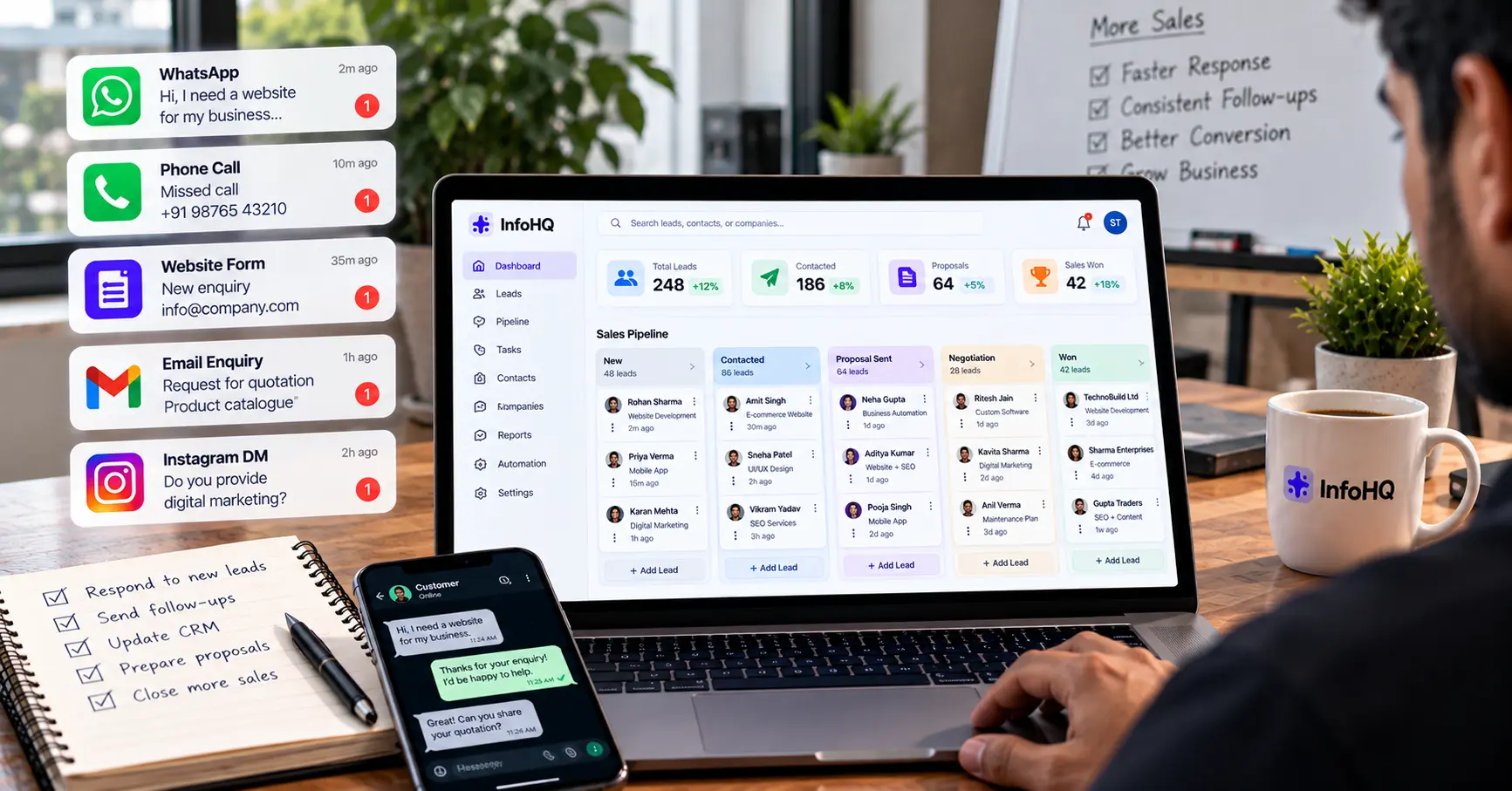
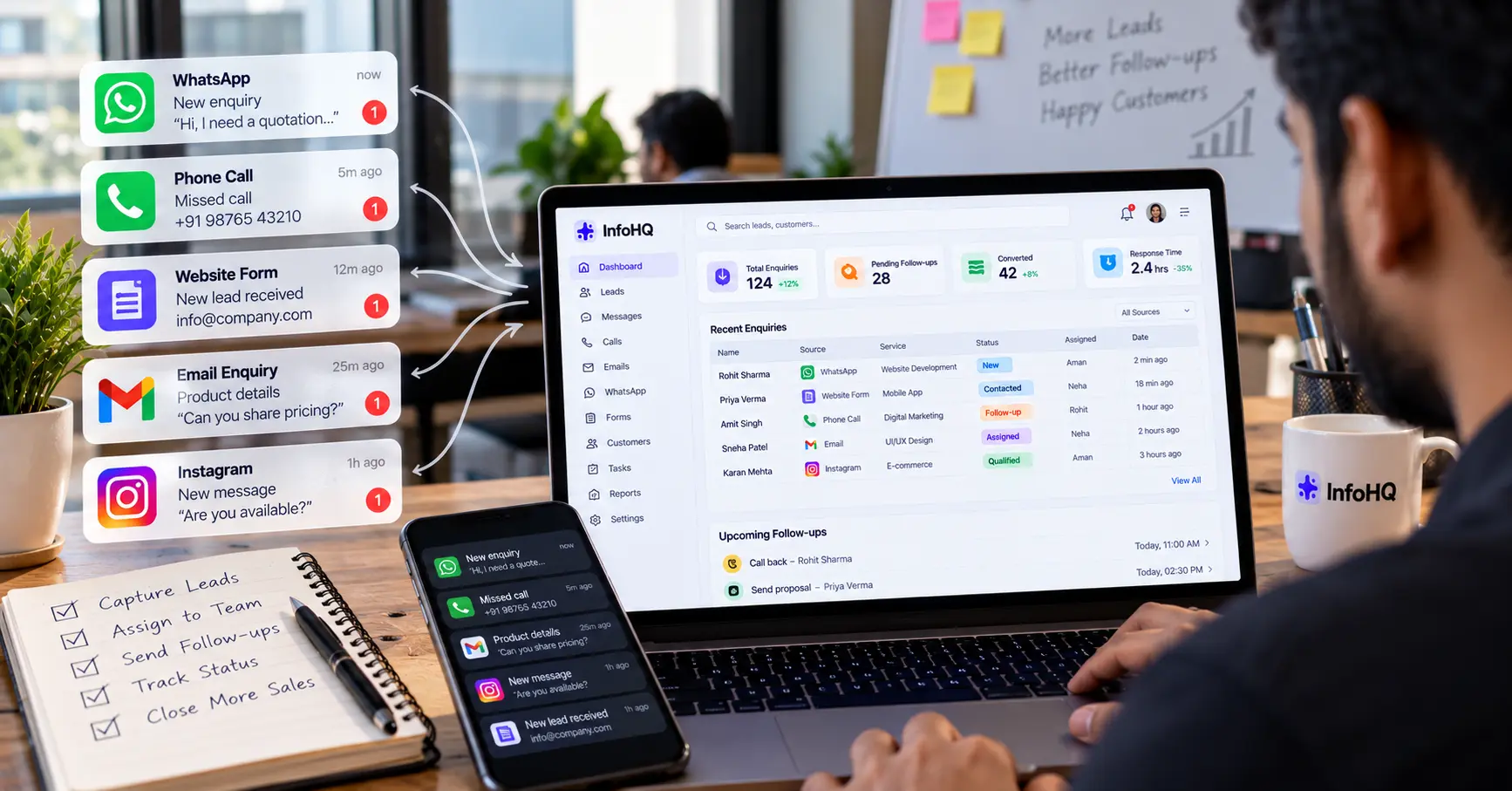
A prospect sends a message on your WhatsApp Business number. Another fills out a quotation form on your website. Someone else calls your office while your senior team is on a client demo.
By the end of the day, some inquiries have received a rushed response, several are buried beneath personal group chats, and others are forgotten entirely.
For growing businesses that receive inquiries through multiple communication channels, this omnichannel chaos is one of the most common causes of lost revenue. The issue isn’t employee carelessness—it is that your business process relies on human memory rather than a centralized system.
A customer enquiry management system eliminates this friction by organizing every incoming request, assigning clear ownership, and guaranteeing that every open conversation has an automated next step.
1. Map Every Inbound Lead Channel
Before selecting or building software, audit exactly how potential clients currently discover and reach your business:
- Website Touchpoints: Main contact form, service quotation forms, and interactive calculators.
- WhatsApp Channels: Direct WhatsApp Business app, click-to-chat links, and social ad buttons.
- Direct Voice Calls: Inbound office phone numbers, mobile lines, and missed call logs.
- Email Inboxes: Sales addresses (e.g.,
contact@infohq.in), team inboxes, and contact form auto-forwards. - Social & Referrals: LinkedIn messages, Instagram DMs, and word-of-mouth client introductions.
Identify which two or three channels generate 80% of your qualified inquiries. Start by integrating and centralizing those priority channels first before trying to connect everything at once.
2. Unify Inquiries into One Central Lead Record
Centralization does not mean forcing your team to monitor a single cluttered screen. It means creating a unified, reliable record for every prospect that any authorized team member can inspect instantly.
A complete customer inquiry record must include:
- Customer Identity: Full name, company, verified phone/WhatsApp, and email.
- Inquiry Timestamp & Source: Exactly when and where the lead originated (e.g., Website /services/web-development/).
- Core Requirement: The specific problem, budget tier, or deadline requested.
- Assigned Account Owner: The individual responsible for the deal.
- Live Status: Current stage in your sales pipeline.
- Next Follow-Up Action: Concrete date and task assigned to the owner.
3. Connect Website Forms Directly to Your CRM Pipeline
Website contact forms should never rely on simple email notifications that can get lost in spam filters or buried under newsletters.
A robust website form pipeline operates in real time:
- Frontend Validation: Ensure phone numbers and email formats are valid before submission.
- Server-Side Ingestion: Webhook sends lead payload to your centralized CRM database.
- Internal Instant Alert: Trigger an immediate Slack notification or WhatsApp alert to the assigned sales representative.
- Client Confirmation: Send an automated, context-aware acknowledgment message reassuring the client that their request is being reviewed.
- Fail-Safe Logging: Preserve form submissions in a backup database table so no lead is ever lost during temporary third-party API downtimes.
Follow the OWASP API Security Top 10 guidelines to ensure submission endpoints are hardened against automated spam bots and injection vulnerabilities.
4. Integrate WhatsApp with Your Core Business Process
WhatsApp is the preferred communication tool for businesses and customers across India. However, managing inquiries through personal phones or disconnected WhatsApp Business apps causes massive visibility gaps:
- Chat history is locked to a single employee’s physical phone.
- When an employee is sick or leaves the company, client conversations and contacts are lost.
- There is no central dashboard to see how many inquiries went unanswered today.
The solution: Official WhatsApp Cloud API integration
By connecting the official WhatsApp Business Platform to your CRM or internal backend:
- Multiple team members can reply from a single business WhatsApp number.
- Inbound chats automatically create or update lead records.
- Automated qualification bots can collect basic project requirements before routing the conversation to a senior engineer.
- Every message is archived securely in your company database.
Ensure your messaging workflows adhere strictly to the official WhatsApp Business Messaging Policy regarding user consent and template guidelines.
5. Standardize Inquiry Statuses and Team Hand-offs
Ambiguity in sales statuses creates confusion. Standardize your pipeline into clear, objective milestones:
| Status | Exact Definition | Trigger for Next Step |
|---|---|---|
| New | Inbound message logged, unreviewed | Auto-assign owner within 15 min |
| Contacted | Initial conversation started | Discovery notes recorded |
| Follow-Up Due | Client waiting for quote or revision | Reminder task active |
| Qualified | Requirement, budget & timeline fit verified | Proposal generation started |
| Converted | Contract signed & initial invoice paid | Onboarding workflow triggered |
| Closed / Inactive | Deal dropped or postponed | Reason archived for reporting |
When statuses are unambiguous, daily standups take five minutes because everyone knows exactly which deals need attention today.
6. Automate High-Impact Alerts and Schedulers
Automation should handle the operational mechanics so your team can focus on client empathy and technical problem-solving:
- Unassigned Lead Escalation: If an inquiry sits in “New” status for more than 30 minutes during business hours, escalate an alert to the operations lead.
- Automated Task Scheduling: When an estimate is sent, automatically generate a follow-up task scheduled for 48 hours later.
- Daily Digest: Deliver an automated morning brief to leadership showing total new inquiries, pending follow-ups, and average response times.
Workflow engines like n8n make it easy to orchestrate these automated rules across your website, WhatsApp, and database without complex custom coding.
7. Measure Key Inquiry Health Metrics
Track four essential indicators to keep your inquiry pipeline running efficiently:
- First Response Time (FRT): Average minutes between lead submission and first personalized reply. (Aim for under 30 minutes).
- Channel Distribution: Percentage of qualified leads originating from Website Forms vs. WhatsApp vs. Phone calls.
- Inquiry Qualification Rate: Percentage of total inquiries that meet your ideal client profile.
- Lead-to-Client Conversion Rate: Percentage of qualified opportunities that result in paying engagements.
Reviewing these metrics monthly will pinpoint whether you need to fix traffic targeting, improve initial sales qualification, or refine follow-up cadences.
Frequently Asked Questions
How can a business manage WhatsApp and website inquiries in one place? Connect both channels via webhooks into a centralized CRM or shared inbox. When a customer submits a website form or sends a WhatsApp message, both feed into the same customer timeline, preventing duplicate records and dropped conversations.
Do I need an expensive enterprise CRM to track customer inquiries? No. Many growing businesses achieve outstanding results using streamlined modern CRMs or self-hosted platforms like n8n connected to PostgreSQL, Airtable, or Zoho, scaling up only as team size demands.
Can WhatsApp inquiry replies be completely automated? Initial greeting, basic qualification questions, and after-hours acknowledgments can be automated. However, technical scoping, commercial proposals, and complex negotiations should always be handled directly by experienced team members.
What is the fastest way to reduce missed customer inquiries? Set up immediate push notifications (via Slack or WhatsApp) for every form submission and assign an accountable person for each inquiry channel.
Final Thoughts
Your potential customers should never have to follow up twice because your business forgot their initial inquiry.
A unified lead record, transparent team ownership, and automated reminders protect your reputation, accelerate your sales cycles, and ensure that every customer interaction starts on a professional footing.