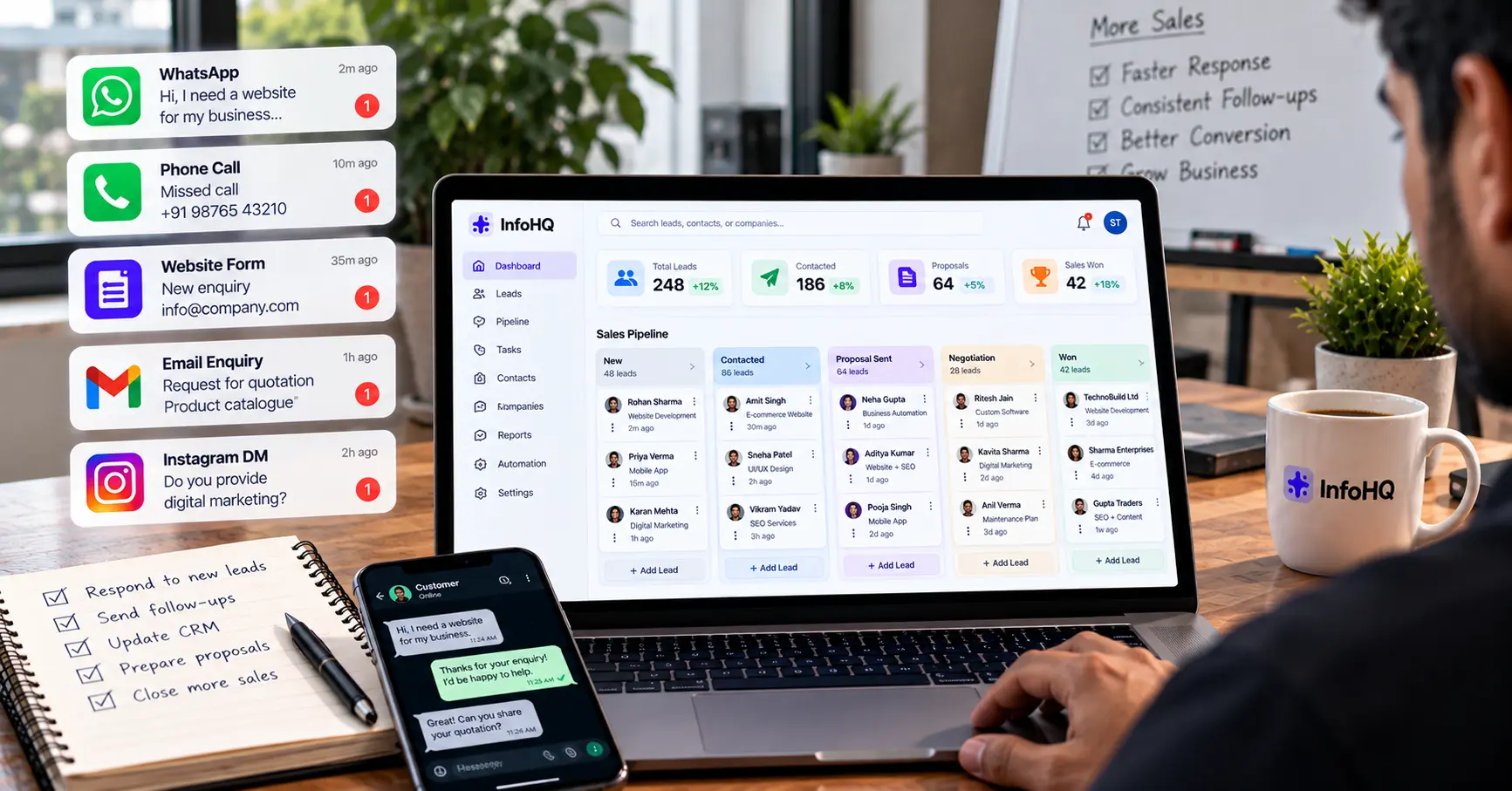
Your business is receiving inquiries. People are filling out website forms, sending WhatsApp messages, and requesting quotations. Yet when you review your closed revenue at the end of the month, the numbers don’t match the volume of incoming leads.
This is one of the most frustrating bottlenecks in business growth.
In most cases, the problem isn’t lead quality or market demand. It is what happens after the enquiry arrives.
A prospect might be waiting for answers while comparing multiple providers. Without an organized lead follow-up system, promising opportunities slip through the cracks, messages sit unread, and quotes go un-followed.
Here is how small and growing businesses can build an automated, disciplined lead follow-up system that turns more inquiries into closed clients.
1. Stop Managing Inquiries Across Disconnected Apps
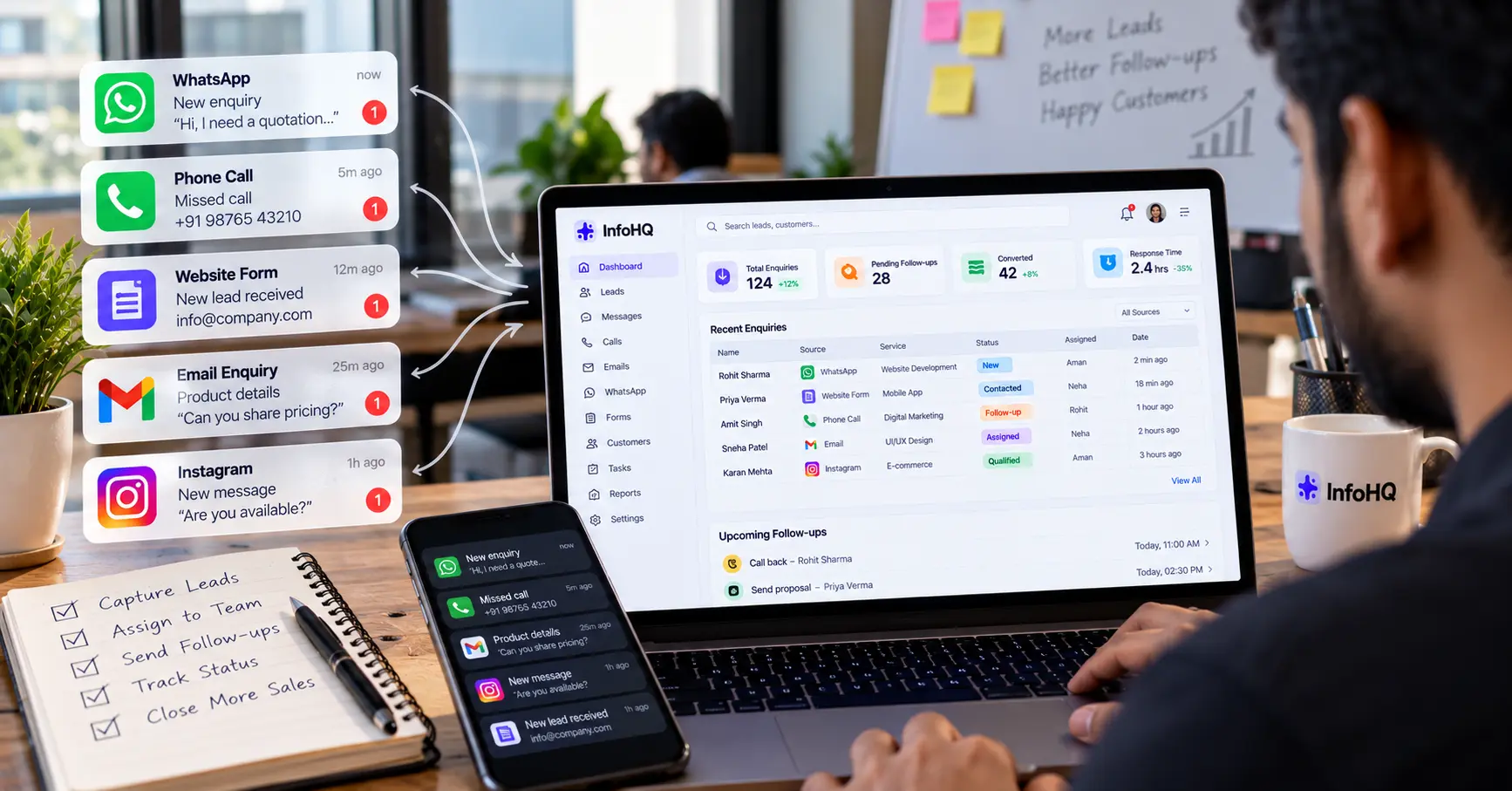
When incoming leads are scattered across personal WhatsApp chats, email inboxes, sticky notes, and spreadsheets, nobody has complete visibility over the sales pipeline.
You may remember the client who called you two hours ago, but completely forget the high-value prospect who submitted a project inquiry on your website yesterday evening.
How to fix it
Consolidate every inbound opportunity into a single central lead registry. Each lead profile should capture:
- Contact Details: Name, company, verified phone/WhatsApp, and email.
- Service Requested: Exact scope or product category required.
- Lead Source: Website form, WhatsApp ad, organic search, or referral.
- Assigned Owner: The specific team member accountable for the deal.
- Pipeline Stage: Current status (e.g., Contacted, Proposal Sent).
- Next Action & Due Date: The exact next step and when it must happen.
For low inquiry volumes, a well-structured spreadsheet can suffice temporarily. However, once multiple team members handle inquiries, a centralized CRM becomes essential to avoid duplicate messages and dropped conversations.
2. Respond with Context, Not Generic Placeholders
Speed to lead matters, but sending an automated “Hello, how can we help?” can feel impersonal and unhelpful.
A high-converting response acknowledges the customer’s specific business requirement right away:
- Weak Generic Reply: “Thanks for reaching out! We will get back to you shortly.”
- Context-Rich Reply: “Hi Rahul, thanks for your inquiry regarding custom SaaS MVP development. We reviewed your note about multi-tenant databases. Could you share your preferred tech stack and target launch month so we can prepare an accurate scope?”
How to fix it
Prepare modular response templates for your core services, allowing your sales engineers to quickly customize details. Ensure automated acknowledgments set realistic expectations without falsely pretending that an engineer has already finished reviewing the scope.
3. Establish a Structured Follow-Up Cadence
Most deals are not closed on the first call. Research shows that 60% of customers say “no” or stay silent multiple times before committing, yet 44% of sales reps abandon follow-ups after just one attempt.
A practical, professional cadence prevents lead leakage:
- Minute 0–15: Lead arrives; automated receipt sent and sales rep alerted.
- Day 1: Discovery call conducted; scope and next milestones agreed upon.
- Day 2–3: Formal proposal or technical estimate delivered.
- Day 5: Polite check-in: “Did you have a chance to review the architecture breakdown?”
- Day 10: Value-add follow-up sharing a relevant case study or technical insight.
- Day 20: Final check-in to confirm if the project has been postponed or rescheduled.
4. Define Clear Sales Pipeline Stages
Without clear milestone definitions, team members will guess what “in progress” means. Establish objective pipeline stages:
| Stage | Definition | Required Action |
|---|---|---|
| New | Form submitted or message received | Assign owner within 15 mins |
| Contacted | Initial discovery call or email sent | Log requirement notes |
| Qualified | Budget, timeline, and scope fit confirmed | Draft proposal |
| Proposal Sent | Scope document and pricing delivered | Schedule review call |
| Negotiation | Contract terms or revisions discussed | Finalize legal & deposit |
| Won / Lost | Deal confirmed or archived | Log reason for analytics |
Clear stages make it immediately obvious where bottlenecks occur: are deals stalling at the proposal phase, or are leads never being qualified in the first place?
5. Automate Repetitive Admin and Reminder Tasks
Sales reps should spend their energy talking to prospects, not copying data between spreadsheets and setting manual phone alarms.
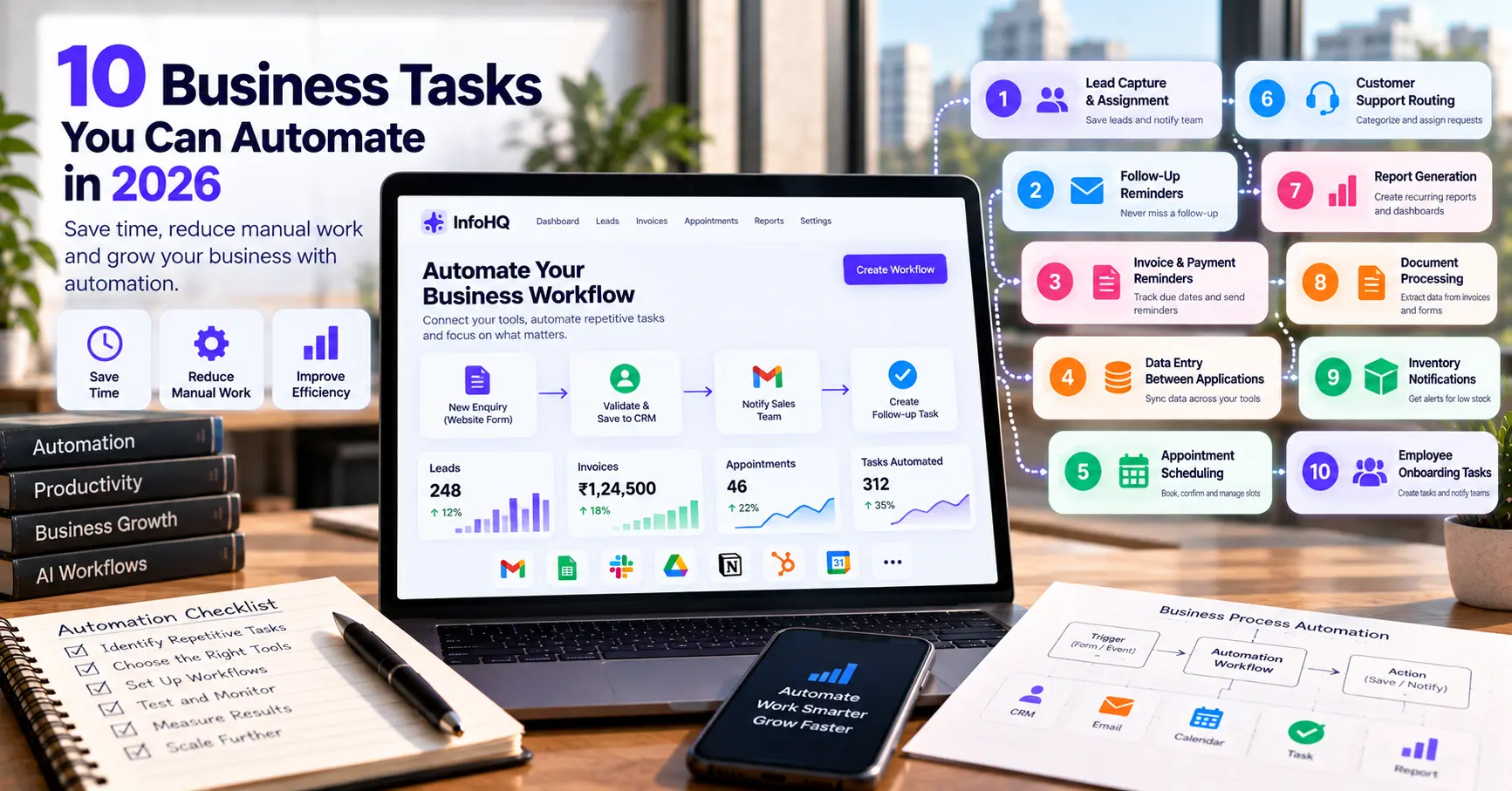
Workflow automation platforms like n8n can connect your website forms, WhatsApp API, and CRM seamlessly:
- Instant Webhook Ingestion: New form entries are parsed and validated automatically.
- Deduplication: Repeated inquiries from the same phone number or email update existing records instead of cluttering the database.
- Team Alerts: Slack or WhatsApp notifications alert the account executive immediately with full inquiry context.
- Task Scheduling: Follow-up tasks are created automatically based on deal stage changes.
6. Track the “Lost Reasons” to Continuously Refine Your Offer
Not every inquiry should or will convert. Prospects might be early in research, out of your budget tier, or seeking features you don’t build.
The real competitive advantage comes from tracking patterns:
- If 40% of lost leads cite pricing, your website may need transparent pricing ranges (like our starting pricing guides) to qualify prospects earlier.
- If deals stall after proposal delivery, your proposals may be too complex, slow to arrive, or lacking verifiable case studies.
- If response times exceed 4 hours, team ownership and routing rules require restructuring.
7. Choose a CRM Architecture That Fits Your Real Capacity
Avoid purchasing bloated enterprise software that requires weeks of training.
A growing business usually needs only four core capabilities:
- Fast mobile access for quick WhatsApp and phone call logging.
- Two-way synchronization with company inboxes and web forms.
- Automated reminders and milestone alerts.
- Clean pipeline reporting with exportable data.
Map your sales journey on paper first. Select or engineer a CRM that fits your team’s real daily workflow rather than adopting unnecessary features.
Frequently Asked Questions
Why are my leads not converting into sales? The most frequent culprits are slow initial response times (taking hours instead of minutes), inconsistent follow-up cadences, vague proposals lacking clear deliverables, and lack of customer trust signals.
Is a CRM strictly necessary for a small business? A spreadsheet works fine when handling 5 to 10 inquiries a month. However, as soon as you have more than one person communicating with clients or inquiry volume grows, a CRM is required to prevent missed follow-ups and lost revenue.
Can lead follow-ups be completely automated? Administrative tasks like acknowledgments, reminders, and data syncing should be 100% automated. However, substantive negotiations, project scoping, and technical advice should always be delivered by knowledgeable humans.
How many times should a business follow up before closing an inquiry? Between 3 to 5 thoughtful follow-ups over a 2 to 3 week window is standard for B2B services. Keep messages helpful, relevant, and concise, and always respect a prospect’s wish to pause discussions.
Final Thoughts
A disciplined follow-up system doesn’t just increase conversion rates—it gives your business predictable operational control.
Start by organizing a single lead source, establishing objective pipeline stages, and automating the administrative handoffs so your team can focus on meaningful customer conversations.