You have started your business. You have a name, a website, a service or product, and perhaps even a social media presence.
But there is one problem.
You don’t have a client.
You keep improving your website, posting on LinkedIn, creating Instagram content, and learning new tools. You may even have a great product or service. But when it comes to finding someone who is willing to pay for it, things become difficult.
This is one of the biggest challenges for new startups and small businesses.
The truth is that having a good product does not automatically bring customers. People need to discover your business, understand what problem you solve, trust your ability to deliver, and have a reason to choose you.
So, how do you get your first client as a startup?
You don’t necessarily need a huge marketing budget, a large team, or thousands of followers. You need a clear offer, the right people to approach, and a consistent way to start conversations.
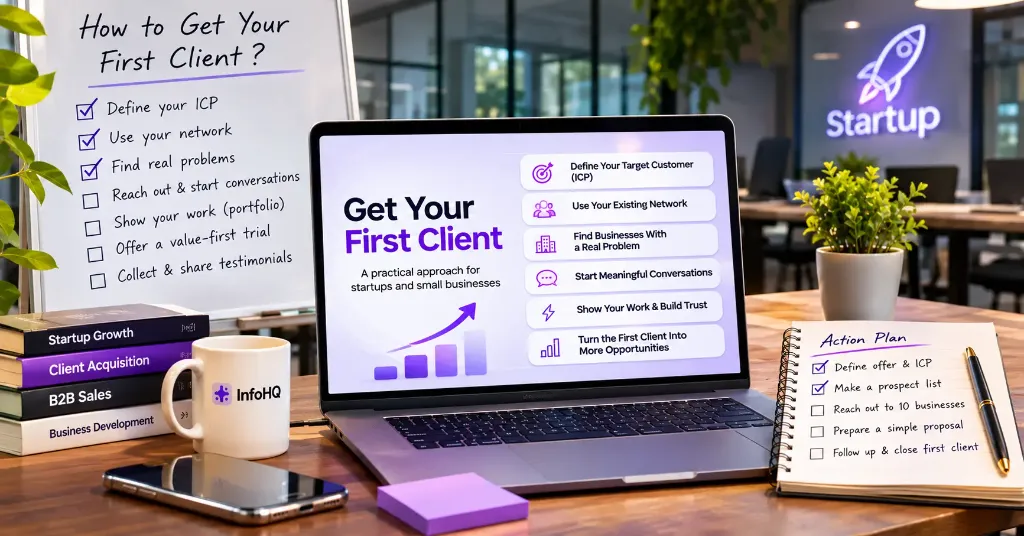
Here are 12 practical ways to find your first paying customer.
1. Stop Trying to Sell to Everyone
One of the biggest mistakes new businesses make is targeting everyone.
For example, saying “We provide software solutions to all businesses” is too broad. It does not tell a potential customer why they should choose you over an established provider.
Instead, define exactly who you want to help.
For example:
- A website development company could target local businesses that still rely on social media pages instead of a professional website.
- A CRM startup could target small sales teams that manage enquiries manually through messy spreadsheets.
- An automation agency could target logistics or clinic businesses that manually handle appointments, invoice reminders, and customer follow-ups.
- A SaaS startup could focus on one niche vertical with a specific, acute operational bottleneck.
This is known as defining your Ideal Customer Profile (ICP).
Before contacting anyone, answer these five foundational questions:
- What type of customer do I want? (Industry, team size, geography, revenue band)
- What specific problem does this customer face daily?
- How are they solving it currently? (Spreadsheets, manual labor, outdated software)
- Why would they pay for my solution? (Saves 10 hours a week, prevents missed leads, increases revenue)
- Who actually makes the buying decision? (Founder, Director, Operations Head)
The more clearly you define your customer, the easier it becomes to find people who actually need your service.
2. Start With People Who Already Know You
Your first client may be closer than you think.
Before spending money on paid advertising or running complex campaigns, look at your existing network.
Think about:
- Friends and family members who run businesses or hold managerial roles.
- Former colleagues, managers, and classmates.
- Local shop owners, merchants, and professional service providers.
- People you have worked with previously on side projects.
- Existing LinkedIn connections in your target industry.
Don’t simply broadcast a desperate message saying, “Please give me work.”
Start a genuine, professional conversation. Explain what you are building, who you help, and what type of customer you are looking to connect with.
Example outreach message:
“Hi [Name], I’ve recently started working on an engineering studio that helps small companies upgrade their websites and automate repetitive customer follow-ups. I’m currently connecting with business owners who may be struggling with these bottlenecks. Do you know anyone who might benefit from this?”
Your goal is not to force an awkward sale on a friend. It is to create relevant awareness and ask for qualified introductions. HubSpot’s customer research consistently shows that leveraging your warm network while building relationships beyond your immediate circle is the fastest path to initial revenue.
3. Find Businesses That Already Have the Problem
One of the most effective ways to find a paying customer is to look for businesses that visibly show symptoms of the exact problem you solve.
Don’t search randomly for companies. Search for signs of a problem.
For example:
| What you offer | What visible signs to look for |
|---|---|
| Website development | Businesses with outdated designs, slow mobile load speeds, or broken layout elements |
| CRM software | Teams tracking enquiries manually via messy Google Sheets or shared email accounts |
| Business automation | Companies repeatedly sending manual payment reminders and appointment confirmations |
| AI customer support | Businesses taking 6+ hours to reply to repetitive WhatsApp or website inquiries |
| E-commerce development | Businesses selling through Instagram DMs without a checkout or inventory system |
| Technical SEO | Established businesses with zero Google search visibility on high-intent local queries |
You can discover potential prospects through Google Search, Google Maps local packs, LinkedIn company pages, local business directories, and niche communities.
Make a structured spreadsheet of 30 businesses that fit your target customer profile. For every prospect, record:
- Business name and website.
- Public contact person (Founder, Managing Director, Head of Ops).
- The exact, verifiable problem you observed.
- How your specific service fixes that problem.
- Date of outreach and conversation notes.
Don’t invent imaginary problems. Highlight real issues that directly hurt their operational efficiency or revenue.
4. Use LinkedIn to Find Potential Clients
LinkedIn is the premier platform for connecting directly with founders, business owners, and corporate decision-makers.
However, simply posting “We provide the best software services” every morning will not generate qualified inbound leads.
Instead, use LinkedIn to demonstrate that you deeply understand your customer’s industry problems.
A practical 7-step LinkedIn strategy:
- Optimize your headline: Change generic job titles to an outcome-driven statement (e.g., “Helping small businesses automate lead follow-ups & custom workflows”).
- Clarify your offer: Use your About section to describe who you help, what you engineer, and how to get in touch.
- Filter decision-makers: Use LinkedIn search filters to find founders and directors in your specific niche.
- Follow company updates: Learn about their current hires, expansions, and operational updates before reaching out.
- Publish practical teardowns: Share short, educational posts dissecting common workflow bottlenecks or website mistakes.
- Start personalized conversations: Send contextual, non-pushy connection requests.
- Follow up respectfully: Share a useful tip or resource rather than immediately pitching.
Example LinkedIn connection message:
“Hi [Name], I came across [Company Name] while researching growing brands in [Industry]. I specialize in website architecture and workflow automation. I was interested in learning how your team currently handles [specific process]. Would you be open to a brief 10-minute exchange?”
Relevance always beats volume. Five thoughtful, well-researched messages will outperform 200 copy-pasted generic spam notes every single time.
5. Build a Portfolio Even Before You Have Clients
This is the classic chicken-and-egg dilemma for every new startup:
A prospect asks: “Have you worked with anyone in our industry before?”
You reply: “Not yet, we’re just getting started.”
The conversation abruptly ends.
The solution is simple: demonstrate your capability through real, working proof-of-concept projects.
You don’t need a signed client contract to prove you can write clean code, build an intuitive user interface, or configure an automated database pipeline.
Create practical demonstration projects:
- Build a high-performance sample website for a realistic business in your target niche.
- Build an interactive demo CRM dashboard showing lead tracking stages.
- Demonstrate an automated WhatsApp webhook workflow that instantly alerts a sales rep when a website form is submitted.
- Deploy a functional FAQ-based AI knowledge assistant using public company documents.
- Record a 90-second screen walkthrough explaining how your solution saves 15 hours of manual work each week.
Clearly label concept work as a demonstration or proof of concept. Never invent fake client reviews or forge testimonials.
Your demonstration must answer one fundamental question in the prospect’s mind:
“Can this team actually deliver what they are promising?”
A working prototype removes buying uncertainty faster than any pitch deck.
6. Offer a Small, Specific First Project
Many new founders fail because they attempt to sell an expensive, multi-month retainer to a prospect who barely knows them.
For a customer who has never worked with you, signing a large contract feels high-risk.
Instead, derisk the transaction by offering a small, high-impact initial project with a clearly defined outcome.
| Service | Traditional Big Pitch (High Risk) | Smaller First Offer (Low Risk) |
|---|---|---|
| Website Development | Full 20-page enterprise website redesign | High-converting single landing page sprint |
| CRM Systems | Multi-department enterprise CRM migration | Simple lead capture and WhatsApp notification setup |
| Automation | Complete ERP business process overhaul | Single automated invoice reminder or appointment workflow |
| AI Integration | Full custom LLM training on private servers | Rapid prototype FAQ AI agent connected to knowledge base |
| Technical SEO | 12-month ongoing retainer contract | Deep-dive technical site audit with top 10 prioritized fixes |
State the scope, deliverables, timeline, and fixed price with total clarity.
A small, paid pilot project allows both sides to evaluate working compatibility. Once you deliver exceptional speed, communication, and craft on a small scope, expanding into a larger retainer becomes effortless.
7. Use Cold Email and Personalized Outreach
You do not have to sit idle waiting for search engines or social algorithms to discover your business. You can identify suitable companies and initiate contact directly.
Cold outreach works exceptionally well for B2B startups—provided your message is concise, deeply relevant, and respectful.
Template: The Value-First Cold Email
Subject: A quick idea for improving [Business Name]'s lead follow-up

Hi [Name],

I came across [Business Name] while reviewing companies in the [Industry] sector.

I noticed [specific, verifiable observation, e.g., your website contact form doesn't offer instant WhatsApp confirmation]. We help businesses bridge this exact gap with automated enquiry routing.

I drafted a quick 2-step concept on how you could automate this so your sales team gets notified within 30 seconds of an enquiry.

Would you be open to a brief 10-minute conversation this week? Happy to share the idea without any obligation.

Best regards,
[Your Name]
Founder, [Company Name]
[Website Link]
Rules for successful cold outreach:
- Identify the sender honestly: Use your business email domain, not a random free email account.
- Explain why you reached out: Mention an actual detail unique to their company.
- Solve a specific problem: Don’t list 20 generic services; focus on one immediate bottleneck.
- Include a clear, low-friction call to action: Suggest a brief conversation, not a 60-minute product demo.
- Comply with privacy laws: Include your business contact details and honor any opt-out requests promptly.
8. Join Communities Where Your Customers Already Spend Time
Your future customers are already gathering online, asking questions, and expressing frustration with their current tools.
Look for active discussions across:
- Relevant Reddit communities (e.g.,
r/smallbusiness,r/entrepreneur, industry-specific subreddits). - Niche LinkedIn groups and founder networks.
- Local chamber of commerce and trade associations.
- Industry-specific Slack channels, Discord servers, and WhatsApp groups.
- Regional business meetups and demo days.
The Golden Rule: Never join a professional group and immediately spam it with links to your services. You will be banned or ignored.
Instead:
- Read and respect community guidelines.
- Search for threads where people describe problems you know how to solve.
- Write detailed, helpful, zero-pitch answers that genuinely solve part of their problem.
- Provide free resources, architecture diagrams, or checklists.
- When a participant asks for technical assistance or vendor recommendations, introduce your service transparently.
When you consistently provide value, community members will naturally view your profile, visit your website, and reach out directly.
9. Turn Your Knowledge Into Content
Modern B2B buyers conduct extensive online research before contacting a service provider.
If your startup publishes practical, technically thorough guides that answer their exact search queries, prospective clients will discover your expertise organically.
For example, a software and engineering studio can publish comprehensive guides answering:
- How to connect WhatsApp Business API to an internal CRM.
- What custom mobile app development costs in India.
- How AI voice agents handle inbound customer support.
- Why websites fail to convert traffic into sales inquiries.
- How to automate invoice extraction and payment reminders.
Distribute your content across LinkedIn, company blogs, YouTube technical breakdowns, and Twitter/X threads.
Don’t treat content as an aggressive sales pitch. Show the problem, break down the architecture, and demonstrate the solution step by step. Following Google’s helpful, reliable, people-first content guidelines will build sustainable organic search traffic that delivers inbound customer inquiries month after month.
10. Build Strategic Partnerships
You don’t have to discover every single prospect on your own.
Other established businesses already have active, trusted relationships with the exact clients you want to serve.
For instance:
- Web development agencies can partner with freelance UI/UX designers and branding studios who don’t write code.
- Custom software and automation studios can partner with digital marketing agencies whose clients need CRM integrations.
- Cloud and DevOps specialists can collaborate with early-stage venture incubators and development shops.
- AI systems engineers can team up with traditional business management consultants.
A healthy referral partnership creates win-win introductions: the partner expands the scope of solutions they can offer their clients, and you receive warm, pre-qualified introductions without expensive marketing spend.
Reach out to non-competing agency owners. Propose a clear referral commission or reciprocal arrangement, establish response timelines, and agree on code ownership standards upfront.
11. Ask for Referrals After Delivering Real Value
Your very first successful project is your most powerful marketing asset.
However, asking for referrals prematurely—before delivering measurable value—can feel pushy and alienate a new client.
The right referral process:
- Deliver ahead of schedule: Ship high-quality code, communicate proactively, and ensure the deployment runs flawlessly.
- Confirm client satisfaction: Ask: “Is the system solving the problem we set out to fix?”
- Request an honest testimonial: Capture a written recommendation or video quote detailing their before-and-after results.
- Publish a case study: Document the challenge, the technical architecture, and the measurable outcome on your website.
- Ask for targeted introductions:
“Thank you for trusting us with this deployment, [Name]. We’re currently taking on two more client projects in [industry]. Do you know another founder or business owner who might be dealing with similar bottlenecks and could use our help?”
A genuine referral carries ten times more trust than any cold advertisement.
12. Follow Up and Keep Track of Every Opportunity
A prospective client who doesn’t respond to your first outreach note is rarely saying “Never contact me again.”
More often, they are traveling, buried under urgent operational tasks, or evaluating quarterly budgets.
Without a structured follow-up process, founders lose more than 60% of potential deals simply because they gave up after one unanswered message.
Track every sales conversation in a dedicated pipeline:
| Prospect | Industry | Status | Last Touchpoint | Next Scheduled Action |
|---|---|---|---|---|
| Company A | Real Estate | Meeting Held | Demo shown yesterday | Send customized scope proposal by Friday |
| Company B | Healthcare | Contacted | Email sent Tuesday | Send follow-up case study on Monday |
| Company C | Logistics | Proposal Sent | Scope shared Oct 30 | Follow up on budget review call |
| Company D | E-commerce | Not a Fit | Budget mismatched | Archive and revisit in 6 months |
In the early days, a simple Google Sheet or Notion board is sufficient. As deal flow increases, implement an automated CRM pipeline that reminds you when to follow up, logs customer interactions, and ensures no high-value inquiry goes cold.
A Practical 30-Day Plan to Get Your First Client
Don’t overwhelm yourself trying to execute 12 different growth channels simultaneously. Follow this focused, 4-week execution blueprint:
┌─────────────────────────────────────────────────────────────┐
│                 30-DAY CLIENT ACQUISITION ROADMAP           │
├──────────────┬──────────────┬──────────────┬────────────────┤
│    WEEK 1    │    WEEK 2    │    WEEK 3    │     WEEK 4     │
│   Prepare    │   Prospect   │   Outreach   │   Follow-Up    │
│  Offer & ICP │  30 Leads    │  & Demos     │   & Close      │
└──────────────┴──────────────┴──────────────┴────────────────┘
Week 1: Prepare Your Offer and ICP
- Define one specific target customer segment and their primary bottleneck.
- Craft a clear, single-sentence value proposition.
- Package a small, fixed-scope introductory project with upfront pricing.
- Build one working demonstration or prototype proving your technical capability.
- Clean up your personal LinkedIn profile and company landing page.
Week 2: Build Your Prospect List
- Research 30 specific businesses that exhibit clear signs of the bottleneck you solve.
- Identify the correct decision-maker for each company.
- Reach out to 10 trusted contacts in your personal and alumni network.
- Engage thoughtfully with target prospects on LinkedIn.
Week 3: Initiate Direct Conversations
- Send 20 highly personalized cold emails and LinkedIn messages using the value-first framework.
- Share your interactive demo project when prospects express interest.
- Conduct initial 15-minute discovery calls to diagnose their operational pain points.
- Send clear, 2-page project proposals outlining scope, timeline, and deliverables.
Week 4: Follow Up, Refine, and Close
- Follow up respectfully on all open proposals and unanswered messages.
- Address scope questions, technical constraints, and payment terms.
- Secure your first signed client agreement and initial deposit.
- Document every objection heard to refine your messaging for the next cycle.
Copy-and-Use: Outreach Message Templates
Template 1: LinkedIn Direct Message
“Hi [Name], I’ve been following [Company Name]’s growth in the [Industry] space. I work with founders to streamline their website performance and automate repetitive customer follow-ups. I noticed a quick opportunity to optimize [specific process] on your current setup. If you’re open to it, I’d be glad to share a 2-minute walkthrough of how we’ve solved this for similar workflows.”
Template 2: WhatsApp Business Introduction
“Hello [Name], this is [Your Name] from [Company Name]. We build custom software and automated workflows for [target niche]. I’m reaching out because I noticed [specific operational observation]. If improving your [specific process] is on your radar this quarter, I’d welcome the chance to share a couple of practical ideas that have worked well.”
Template 3: Gentle Follow-Up Note
“Hi [Name], following up briefly on my note from last week. I know how hectic schedules get. If solving [specific bottleneck] is currently a priority for your team, I’m here to help. If the timing isn’t right, no problem at all—wishing you continued success with [current initiative]!”
Frequently Asked Questions
How do I get my first client as a startup? Start by choosing a single, well-defined customer segment rather than trying to sell to everyone. Identify an acute problem they face, build a working demonstration project to prove your capability, reach out through your personal network and personalized LinkedIn outreach, and offer a small, low-risk pilot project with a fixed scope.
How can I get clients without a marketing budget? Use founder-led outreach, personal networking, strategic agency partnerships, active participation in relevant professional communities, and high-value technical content. These channels require focused time, consistency, and discipline rather than expensive ad spend.
How many prospects should I contact to get my first client? There is no fixed formula, but starting with a carefully researched list of 30 to 50 targeted prospects is a reliable benchmark. Prioritize deep personalization and relevance over blasting generic messages to hundreds of strangers.
How can a new business get clients without prior experience? Build realistic concept projects, interactive prototypes, and open-source demonstrations. Walk prospective clients through your technical methodology and problem-solving process. Transparent capability combined with a small, derisked initial project will earn trust even without a long client history.
Should a startup offer free work to win its first customer? Never promise unlimited free work. Instead, consider offering a small, free diagnostic audit or a discounted pilot project with strict boundaries and agreed milestones. If you deliver value for free, secure a written agreement that the client will provide an honest testimonial and referral upon successful completion.
Is LinkedIn effective for B2B startup client acquisition? Yes. LinkedIn allows founders to connect directly with business owners, CTOs, and managing directors. By publishing practical teardowns, optimizing your profile around customer outcomes, and engaging in relevant industry discussions, you can build meaningful conversations that turn into paying client relationships.
Should I hire a sales rep before closing my first customer? No. In the early stages of a startup, founders must lead the first sales conversations themselves. Founder-led sales allows you to hear objections directly, understand pricing sensitivity, refine your value proposition, and discover what features customers actually care about. Only hire a sales rep once you have a proven, repeatable sales process.
Final Thoughts: Your First Client Changes Everything
Closing your first client is about far more than your initial bank deposit.
It delivers the most valuable asset in entrepreneurship: real market validation.
You learn what paying customers truly care about, what deliverables matter most, which pricing models work, and how to articulate your value clearly. You also gain the opportunity to produce your first verified case study and earn your first customer referral.
Don’t spend another month tweaking website color schemes in isolation.
Pick one customer segment. Find a real bottleneck. Build a working demonstration. Start conversations. Follow up consistently.
Your first paying customer will not come from your next social media post. It will come from the next meaningful conversation you initiate.
Ready to Build a Serious Digital Presence for Your Business?
A modern, high-performance website and automated lead-handling infrastructure make it significantly easier for prospective clients to discover, trust, and hire your company.
InfoHQ engineers custom websites, high-concurrency SaaS applications, enterprise CRM systems, and AI-powered business automations for startups and growing enterprises across India.
Whether you need a high-converting digital presence or an automated workflow to manage your client inquiries, talk directly with our engineering team:
Explore Solutions and Schedule a Free Consultation with InfoHQ →
References and Further Reading
- HubSpot — 7 Best Ways to Find Your First Customer & Keep Them
- Y Combinator — How to Get Your First Customers
- Y Combinator — YC’s Essential Startup Advice by Geoff Ralston
- Stripe Atlas — Your First 10 Customers: Founder-Led Sales Playbook
- Paul Graham — Do Things That Don’t Scale
- HubSpot — How to Build an Ideal Customer Profile (ICP)
- Google Search Central — Creating Helpful, Reliable, People-First Content
Editorial Note: This guide synthesizes proven startup sales frameworks with practical engineering and client acquisition practices. Results vary across industries, services, and market conditions. Sustainable client acquisition relies on consistent execution, continuous offer refinement, and exceptional service delivery.