For service businesses, healthcare clinics, real estate agencies, and professional firms, the phone remains the highest-converting customer channel. When an interested customer calls, they want an immediate answer.
Yet, businesses miss an estimated 25% to 40% of inbound calls due to busy phone lines, after-hours queries, or staff occupied with on-site clients. Each unanswered ring represents lost revenue and a customer who simply calls the next competitor on Google.
This challenge explains why Gartner identifies voicebots and agentic AI platforms among the primary emerging technologies expected to deliver transformative customer service value and measurable operational efficiency over the next three to five years.
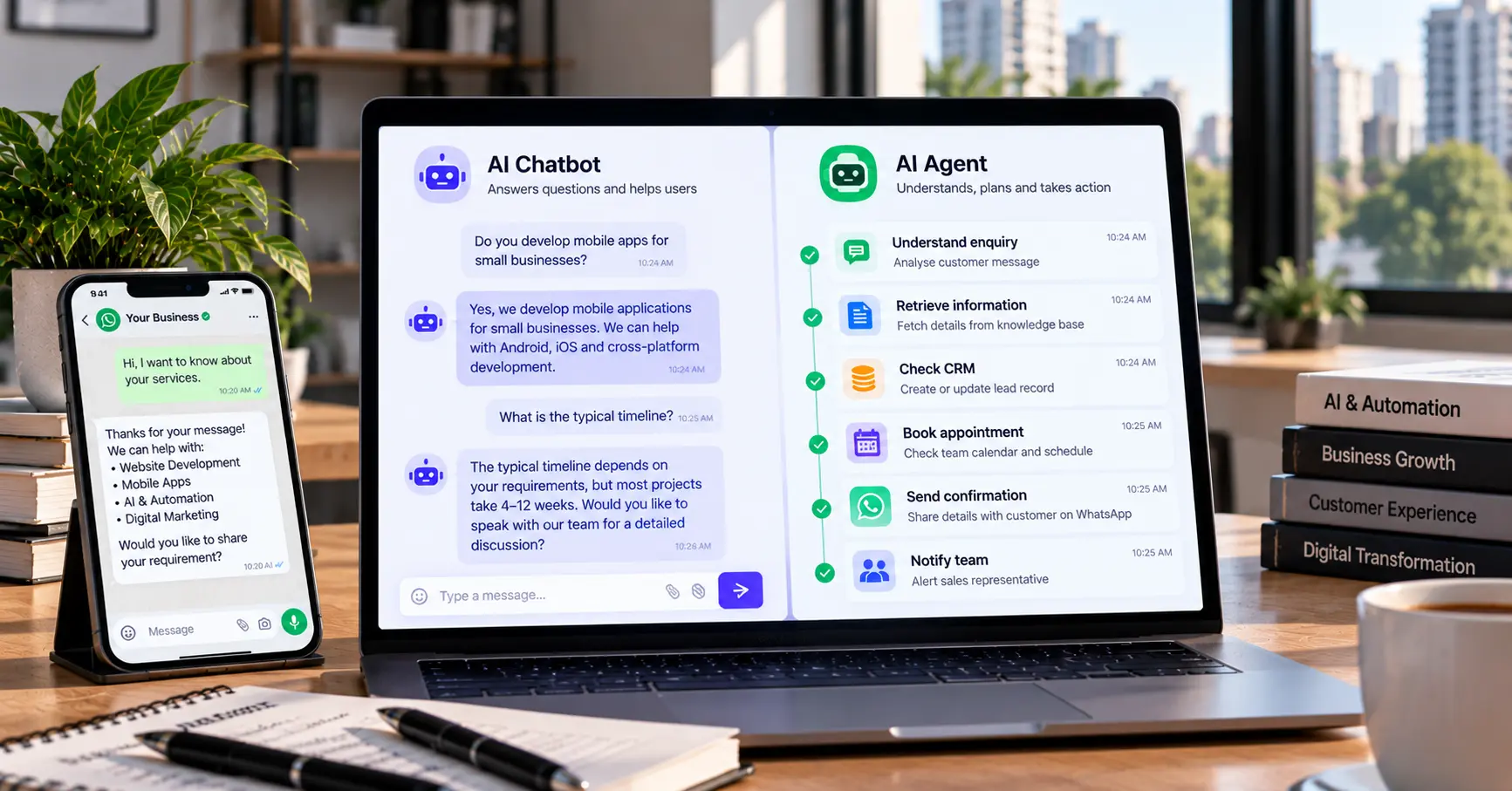
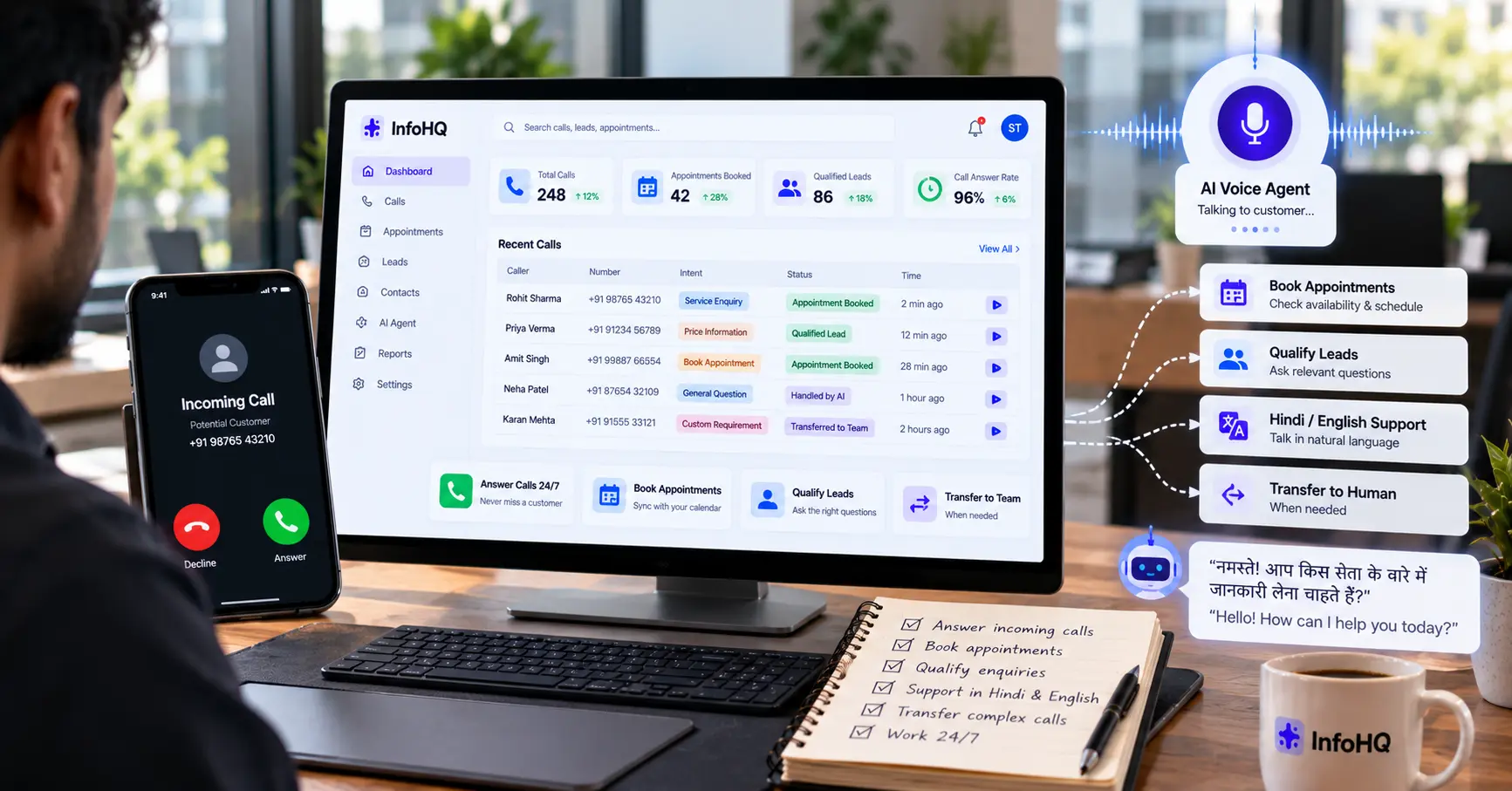
Modern AI voice agents are not the frustrating, clunky IVR menus of the past (“Press 1 for Sales, Press 2 for Support”). They are conversational, sub-second latency speech intelligence systems that can understand natural spoken language, check real-time database availability, qualify leads, and book calendar appointments seamlessly.
Here is an objective, engineering-grounded look at what AI voice agents can do today, how they operate in bilingual markets like India, and their practical limitations.
What Is an AI Voice Agent?
An AI voice agent is an autonomous software system that conducts human-like, two-way verbal phone conversations. Powered by Large Language Models (LLMs), fast Speech-to-Text (STT), and neural Text-to-Speech (TTS), voice agents interpret caller intent, retrieve internal business data, and execute tasks such as scheduling, lead qualification, and CRM logging in real time.
Unlike rigid automated phone trees, an agentic voice bot listens, reasons, interrupts gracefully when the caller speaks, and provides accurate answers grounded in your business data.
Caller Speaks  ──►  Speech-to-Text (STT)  ──►  LLM + Enterprise RAG
                                                       │
Caller Hears   ◄──  Neural Voice (TTS)   ◄──  Function Call / DB Sync
The breakthrough making voice AI viable today is end-to-end latency reduction. By processing audio streams in under 500 to 700 milliseconds, modern voice models (utilizing architectures like Deepgram, Groq, Whisper, and ElevenLabs/Cartesia) create fluid, natural conversation without awkward pauses.
1. 24/7 Inbound Call Answering Without Busy Signals
Inbound call spikes frequently overwhelm human front-desk staff. A busy clinic receptionist cannot schedule an appointment, answer insurance questions, and greet in-person patients at the exact same moment.
An AI voice agent functions as an always-on, zero-wait-time digital receptionist:
- Zero Missed Inquiries: Answers every phone call on the first ring, whether it arrives at 2:00 PM on a Monday or 11:30 PM on a Sunday.
- Infinite Scalability: Can handle dozens of concurrent phone conversations simultaneously without putting anyone on hold.
- Accurate Business FAQ Resolution: Instant answers to recurring questions: office hours, clinic location, accepted payment methods, service packages, and cancellation rules.
2. Automated Appointment Booking and Live Calendar Sync
Booking an appointment over the phone traditionally requires 3 to 5 minutes of back-and-forth calendar checking, typing names, and confirming contact numbers.
An AI voice agent handles this entire workflow during the call:
- Identifies Intent: “I’d like to book a consultation with Dr. Sharma this Thursday.”
- Queries Live Calendar API: The AI inspects your calendar database (Google Calendar, Cal.com, Calendly, or custom CRM) in real time to locate open slots.
- Offers Contextual Options: “Dr. Sharma has openings this Thursday at 11:30 AM and 4:00 PM. Which one suits you better?”
- Locks the Slot: Once the caller confirms, the AI blocks the calendar slot, logs patient/client notes, and triggers an instant confirmation SMS and WhatsApp message with location directions.
- Handles Rescheduling and Cancellations: Callers can call back anytime to change their appointment time without human intervention.
3. Intelligent Lead Qualification and Instant CRM Routing
Not every incoming call has the same commercial priority. A prospect looking for an enterprise development retainer requires a different conversation than someone looking for free student internships.
AI voice agents can conduct structured, polite qualification scripts:
- Scope & Problem Discovery: What specific service or technical assistance does the customer need?
- Budget Alignment: Does the caller have a budget tier aligned with your starting packages?
- Timeline Assessment: When do they need the project or consultation delivered?
Once qualified, the agent generates a clean, structured transcript and pushes the contact record straight into your CRM (Zoho, HubSpot, Salesforce, or custom PostgreSQL database via business automation webhooks), tagging the opportunity with high, medium, or low priority.
4. Bilingual Hindi, English & “Hinglish” Natural Language Support
In multilingual business hubs like Mumbai, Delhi, Bengaluru, and Pune, callers rarely speak in textbook English or formal Hindi. They speak conversational Hinglish—seamlessly mixing languages within a single sentence:
“Haanji, mujhe commercial web application ke liye quotation chahiye tha. Kya aapki team Pune mein available hai?”
Traditional automated bots break down completely when confronted with code-switching or regional Indian accents. Modern voice pipelines, fine-tuned on multilingual Indian speech models (such as Sarvam AI, Whisper India, and localized LLMs), comprehend code-switched phrases effortlessly.
The voice agent responds in the caller’s preferred dialect and tone—whether formal corporate English, natural conversational Hindi, or mixed Hinglish—ensuring caller comfort and zero communication friction.
5. Intelligent Warm Transfers to Live Staff
An effective AI voice agent is designed to augment human staff, not isolate customers behind an impenetrable digital wall.
When a caller presents a situation requiring human judgment—such as an urgent medical emergency, an upset client requiring empathy, or a high-ticket enterprise contract negotiation—the AI performs a warm call transfer:
AI Voice Agent: "I understand you need immediate assistance with an urgent billing discrepancy.
                 Please hold for just a moment while I transfer you directly to Mr. Verma from our senior accounts desk."
Before ringing the human agent’s phone, the AI sends a 10-second summary to the employee’s screen (caller name, problem, and verification status). The human answers the call fully informed, without forcing the customer to repeat themselves from scratch.
Comparison: Traditional Receptionist vs. Robotic IVR vs. Agentic AI Voice Agent
| Feature | Human Front-Desk | Legacy IVR (“Press 1”) | Agentic AI Voice Agent |
|---|---|---|---|
| Availability | 8 to 10 hours / day | 24/7 | 24/7/365 |
| Concurrent Calls | 1 call at a time | High (Robotic) | Unlimited Simultaneous |
| Response Latency | Immediate human | Annoying delays | Sub-second (500-700ms) |
| Conversation Style | Natural human | Scripted number keys | Fluid conversational dialogue |
| Bilingual Hinglish | Dependent on staff | Not supported | Native trilingual support |
| Calendar Booking | Manual typing | Impossible | Instant live API synchronization |
| Average Cost | ₹25,000–₹45,000/mo/agent | Low | Fraction of staffing overhead |
Real Limitations: Where AI Voice Agents Are Not Ready
Despite rapid advancements, voice AI is not a universal replacement for every phone interaction. Deploying voice AI responsibly requires understanding its current technical boundaries:
1. High Background Noise Environments
When callers speak from crowded train stations, traffic jams, or construction sites, ambient audio interference can degrade Speech-to-Text accuracy, leading to transcription errors.
2. High-Stakes Emotional Escalations
AI agents cannot experience genuine human empathy. When a customer is deeply angry, grieving, or dealing with a crisis, automated voice responses can sound cold. These calls must be detected via sentiment analysis and immediately routed to empathetic human managers.
3. Highly Ambiguous or Open-Ended Negotiations
While AI agents excel at answering FAQs, scheduling, and qualifying leads against structured parameters, they should not be authorized to negotiate complex legal contracts or close unconstrained financial terms without human sign-off.
4. Telephony Audio Compression (PSTN)
Standard mobile phone networks compress audio into 8kHz narrow-band telephone codecs. Engineering clean voice pipelines requires advanced noise suppression and acoustic echo cancellation (AEC) to maintain high accuracy over mobile networks.
Frequently Asked Questions
Can AI voice agents really answer incoming business calls naturally? Yes. Modern voice agents combine fast Speech-to-Text, Large Language Models, and low-latency neural speech engines to speak with sub-second response times, natural pauses, and human intonation, avoiding the robotic feel of legacy telephone trees.
How does an AI voice agent book appointments without double-booking? The voice agent connects directly to your calendar or CRM API (Google Calendar, Outlook, Cal.com, Zoho, etc.). It checks availability in real time during the call, blocks the selected slot instantly, and dispatches SMS/WhatsApp confirmations to prevent scheduling conflicts.
Can an AI voice agent speak Hindi and Indian English? Yes. Localized AI voice models are trained on Indian accents and can understand colloquial Hinglish—including mixed vocabulary and code-switching commonly spoken across Indian cities.
What happens if the AI does not understand a caller’s request? When an inquiry exceeds the AI’s knowledge base or confidence threshold, the agent politely acknowledges the complexity and performs a warm transfer to an available human staff member, passing along the conversation summary.
Final Thoughts
The goal of implementing AI voice agents for business is not to eliminate human interaction. It is to eliminate missed business opportunities, hold music, and administrative friction.
By letting AI voice agents handle after-hours inquiries, routine FAQs, and appointment scheduling, your human team can focus on in-person customer relationships, high-value sales negotiations, and complex operations.
Explore how intelligent voice systems can connect to your website, CRM, and phone lines with InfoHQ’s AI Engineering team.