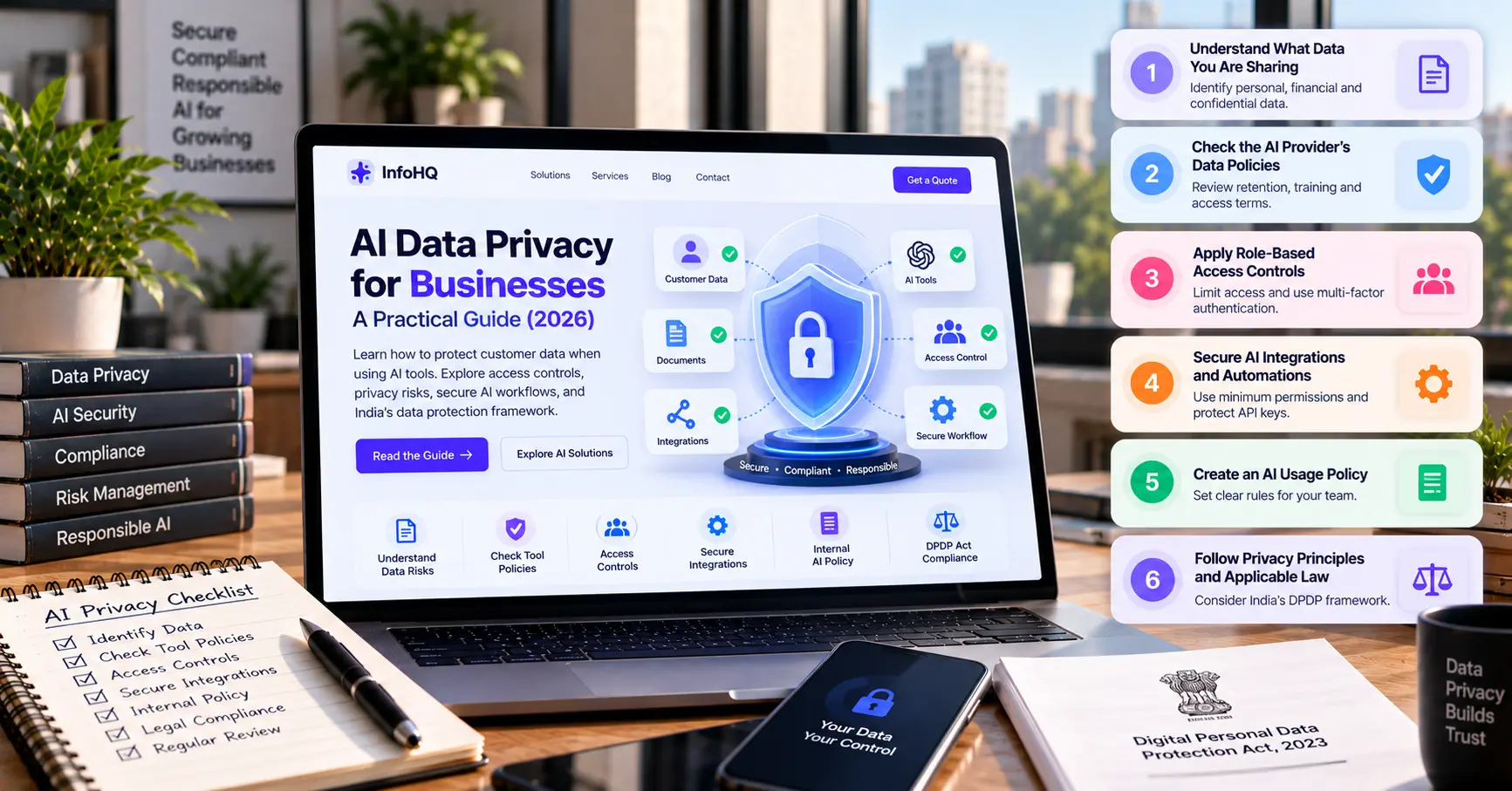
AI tools can help businesses write content, analyse documents, support customers and automate workflows. Used without clear data protection practices, they can also expose customer information, confidential documents and internal records.
AI data privacy for businesses means understanding what information an AI system receives, how it is processed, who can access it, and how it is stored or shared.
Indian businesses should also consider their legal obligations, including the Digital Personal Data Protection Act, 2023 and its rules. MeitY published the Digital Personal Data Protection Rules, 2025 in November 2025, and the provisions come into effect in phases. Check the official MeitY documents and take legal advice for your own situation.
1. Understand What Data You Are Sharing
Before entering information into an AI tool, identify whether it contains personal, financial, confidential or commercially sensitive data.
Examples include:
- Customer names, phone numbers and email addresses.
- Invoices and payment records.
- Employee information.
- Contracts and business proposals.
- Passwords, API keys and access tokens.
- Internal reports and customer support conversations.
Best practice: Use sample, anonymised or redacted data whenever real personal information is not needed.
Never paste passwords, private keys or access tokens into a general AI chat.
2. Check the AI Provider’s Data Policies
Different AI products have different terms for data retention, model training, access and enterprise controls.
Before using a tool for business information, review:
- Whether submitted data is used to train models.
- How long prompts, files and outputs are retained.
- Whether administrators can manage data access.
- What deletion and export options are available.
- Whether the product offers contractual privacy commitments.
- Whether the tool meets your organisation’s security requirements.
Do not assume every AI service handles data the same way. Read the terms for the exact product and plan you intend to use.
3. Apply Role-Based Access Controls
Employees should only have access to the data they need for their jobs.
For example, a marketing assistant may need approved product descriptions but not payroll records or customer identity documents.
Use individual accounts, multi-factor authentication where available, restricted permissions and regular access reviews. Avoid sharing a single administrator account across the team.
4. Secure AI Integrations and Automations
AI systems connected to a CRM, database, email platform or cloud storage can create extra privacy risks.
Follow these practices:
- Use the minimum permissions required.
- Keep API keys in secure environment variables or a secrets manager.
- Validate incoming data.
- Limit what information is sent to external AI services.
- Log important actions without storing sensitive content unnecessarily.
- Test integrations before connecting them to production systems.
- Require approval for high-impact actions.
A workflow that can read customer records should not automatically get permission to delete or export all of them. For help with application-level security, see our cybersecurity service.
5. Create an AI Usage Policy
A short internal policy helps employees understand which tools are approved and what they can share.
Your policy should specify:
- Approved AI tools and business purposes.
- Data that must never be uploaded without authorisation.
- Rules for handling customer and employee information.
- Human review requirements.
- How to report suspected data exposure.
- Who is responsible for reviewing new AI tools.
Employees should also verify AI-generated outputs before using them in customer communications or important decisions.
6. Follow Privacy Principles and Applicable Law
India’s DPDP framework covers the processing of digital personal data, including consent-related requirements where they apply, the responsibilities of data fiduciaries, and reasonable security safeguards.
Your business should assess the legal basis for processing, give the required notices, collect only necessary data, and set appropriate security and retention practices. The exact obligations and commencement dates depend on the provisions and rules that apply to you.
For legal interpretation, use the official Digital Personal Data Protection Act, 2023 and MeitY’s official publications. This article is general information, not legal advice.
AI Privacy Checklist for Businesses
Before deploying an AI tool, ask:
- Have we identified the data being shared?
- Is this tool approved for the intended use?
- Have we checked its data retention and training terms?
- Are access permissions limited?
- Are integrations protected?
- Can sensitive information be redacted?
- Is there a process for reporting incidents?
- Have we assigned responsibility for monitoring the system?
Frequently Asked Questions
Is it safe to upload customer data to AI tools?
Only after checking the tool’s policies, your business requirements, permissions and applicable legal obligations. Redact unnecessary personal information wherever possible.
Can AI tools store the information I enter?
Data handling differs by product, plan and configuration. Review the provider’s current privacy and retention documentation before sharing confidential information.
Does the DPDP Act apply to every business using AI?
Its application depends on the data, the processing activities, the legal provisions and the applicable rules. Assess your own circumstances instead of assuming you are exempt or already compliant.
What is the safest way to introduce AI at work?
Start with an approved use case, limit the data shared, restrict permissions, test the workflow, and keep human oversight for sensitive decisions.
Final Thoughts
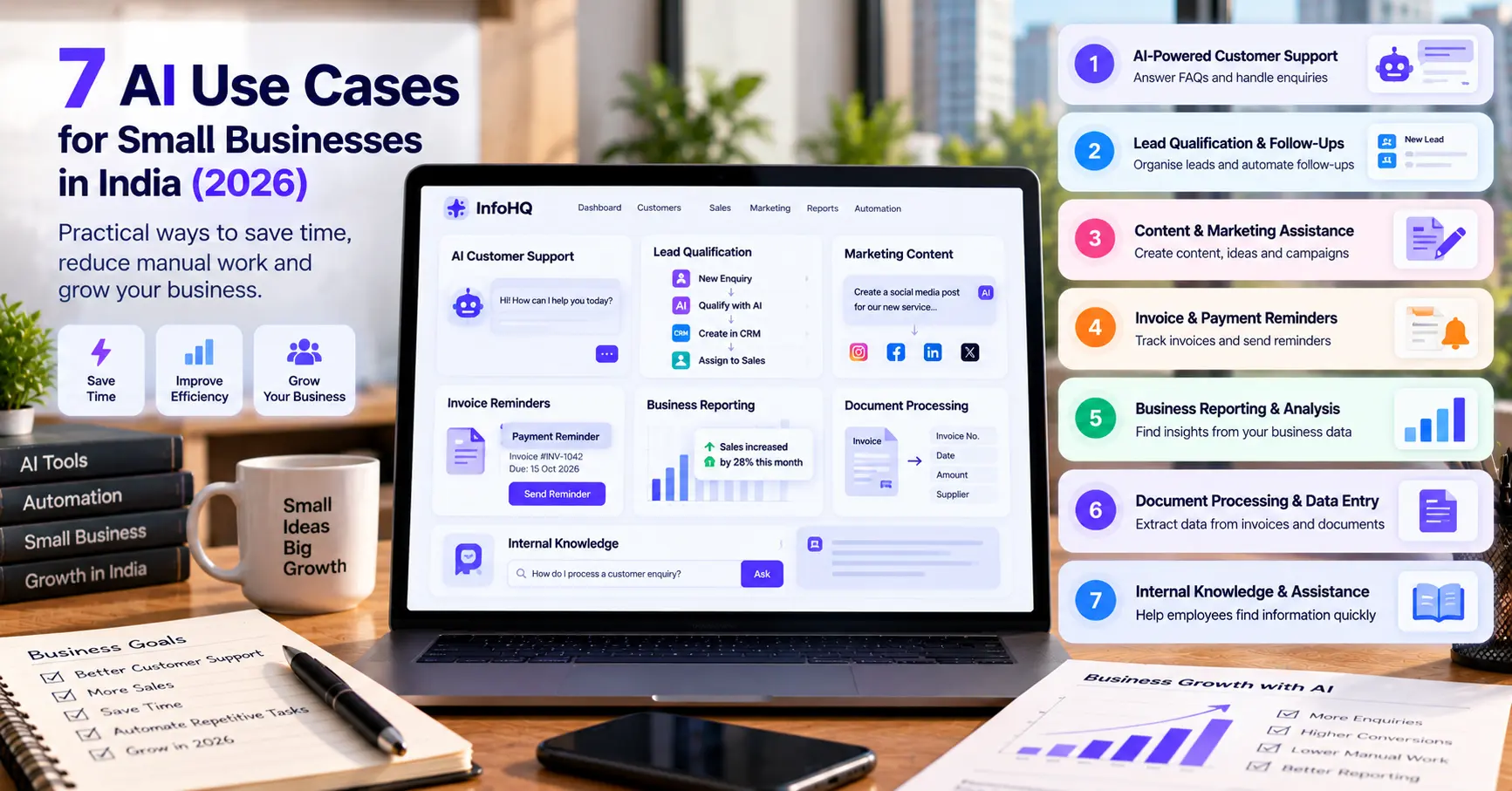
AI adoption should include data protection from the start, not as an afterthought. Clear policies, restricted access, secure integrations and employee awareness help businesses reduce avoidable privacy risks. If you are still deciding where to begin, read our list of AI use cases for small businesses in India.
Need help implementing AI securely? InfoHQ is an AI and software engineering studio headquartered in Prayagraj, with operations also in Pune. We help businesses across India plan AI integrations and automation workflows with security and operational requirements in mind. See our AI and intelligent systems service or contact us.