Ask a small business owner how many enquiries came in last month and you’ll get a rough guess. Ask how many were answered the same day, and the guess gets quieter.
That gap is where most leads are lost. Not at the pricing stage, and not because a competitor was cheaper. Someone sent a message on a Saturday, the person who usually replies was out, and by Monday the buyer had already spoken to someone else.
It’s a common pattern, and it’s rarely about missing software. It’s about nobody being clearly responsible for the next step.
The usual leaks
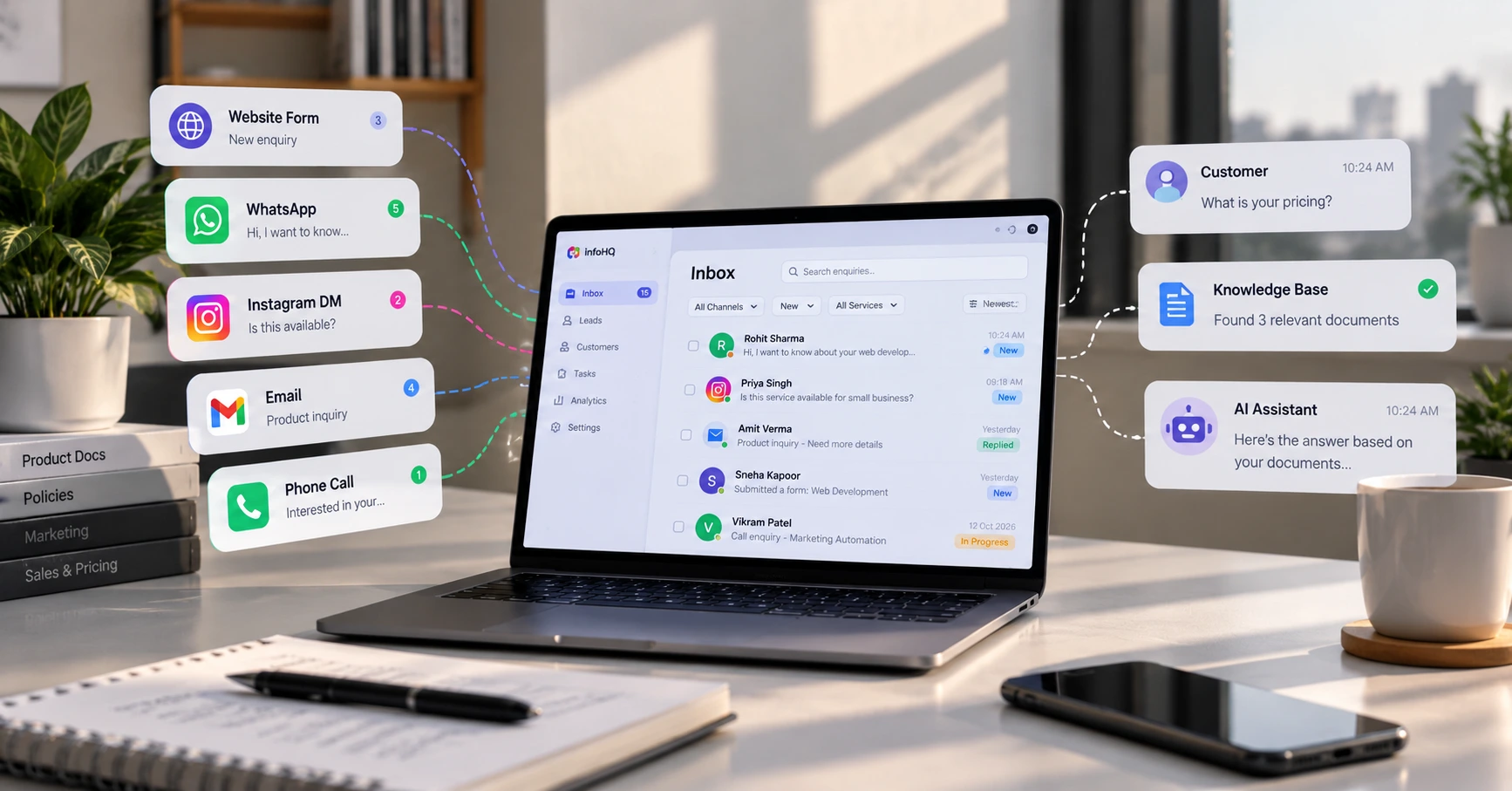
Enquiries arrive from more places than most people count: the website form, WhatsApp, Instagram DMs, a phone call someone scribbled on paper, an email to a shared address. Each lands somewhere different, and whoever happens to see it first becomes its owner by accident.
A few things tend to go wrong from there:
- Nobody knows which enquiries are still waiting for a reply.
- The same person gets contacted twice because two team members both followed up.
- There’s no record of where the lead came from, so you can’t tell whether Instagram or the Google listing is doing the work.
- Follow-ups depend on somebody remembering.
None of this needs AI. It needs a boring, reliable process.
Start with one list
Before automating anything, pick one place where every enquiry gets written down. A shared spreadsheet is fine. Columns: date, name, how to reach them, source, what they asked for, who owns it, status, next follow-up date.
Run it by hand for two weeks. You’ll learn how many enquiries you really get, and which columns your team actually fills in. If nobody bothers with “source”, you probably don’t need it. If people keep arguing about “owner”, that’s the real problem, and no tool will fix it for you.
Then automate the dull parts
Once the manual version works, automate the steps that are purely mechanical:
- Website form submissions land in the sheet on their own.
- The person gets a quick acknowledgement, something like “got your message, someone will reply by tomorrow”, so they aren’t left wondering.
- Each enquiry is assigned to an owner by a simple rule, such as service type or city.
- If an enquiry is still marked “new” after a time you’ve chosen, the owner gets a reminder.
- Once a week, someone gets a short summary: how many came in, how many were answered, how many are stuck.
Tools like n8n, Make and Zapier can handle all five without much code, and they’re the ones we reach for in this kind of work. For a business getting a few dozen enquiries a week, that’s plenty.
WhatsApp is the awkward one
A lot of enquiries in India arrive on WhatsApp, and that’s where tidy systems tend to fall apart. The regular WhatsApp Business app works for a small team replying by hand, but it doesn’t connect neatly to other tools. To automate replies or log chats into a sheet, you generally need the WhatsApp Business API through an approved provider, which has its own setup process and per-message charges. Those terms change, so check the current ones before you plan around it.
If you’re not ready for that, there’s a decent middle path. Put a click-to-chat link on your website with a pre-filled message that mentions the service they’re asking about. The first line of every chat then tells you what the person wants, and someone can log it in the sheet in ten seconds.
When custom software is worth it
Later than most agencies will tell you. A spreadsheet plus a no-code workflow tool carries a small business a long way. Building something custom starts to make sense when:
- volume is high enough that per-task pricing on no-code tools gets expensive,
- the data is sensitive and shouldn’t pass through third-party tools,
- the routing rules have grown so complicated that the workflow no longer fits on one screen,
- or leads need to connect with your own software, like a booking or billing system.
If none of that sounds like you yet, save the money.
Try this week
- Write down every channel your enquiries arrive on.
- Pick the one place they’ll all be logged.
- Give each enquiry one named owner. A person, not a team.
- Decide what “answered in time” means for you, in hours, and write it down.
- Look at the list again next Friday.
That’s most of the value, and it costs nothing. The automation only makes it stick.